
Vietnam is one of the most attractive growth markets in Southeast Asia, and the instinct is to assume that operating there means setting up a Vietnamese company. For most businesses testing or scaling the market, it doesn't. You can sell to Vietnamese customers and pay Vietnamese partners without incorporating locally, if your payment setup is built for it.
Here's how to run both directions of Vietnamese money movement without a local entity.
Doing business in Vietnam used to mean a local presence: an entity to open a bank account, to accept local payments, to pay suppliers in-country. That's a heavy, slow commitment to make before you know the market is worth it.
A cross-border provider removes the barrier by giving you local collection and local payout as a service. You collect the way Vietnamese customers pay and disburse the way Vietnamese recipients expect, all through one integration, while staying incorporated wherever you already are. The market entry becomes a payments decision, not a legal-and-tax project.
Getting paid in Vietnam means accepting how Vietnam pays. Card penetration is lower than local methods, and buyers reach first for bank transfers, QR payments, and domestic wallets like ZaloPay. A checkout that only offers international cards will lose a large share of Vietnamese buyers who never see an option they trust.
A cross-border payment gateway lets you present those local methods at checkout and collect without a Vietnamese entity or a local acquirer of your own. Vietnamese customers pay the way they always do, and you receive the funds into your existing setup. That alone is the difference between a Vietnamese market that converts and one that bounces at the payment step.
The other direction is paying out: suppliers, sellers, contractors, staff. The goal is money that lands in VND, cleanly, the first time. That means paying into local Vietnamese accounts in local currency over local rails, not slow international wires that arrive late and cost more.
Two things make payouts reliable. Pay in VND to VND accounts, so there's no messy conversion at the recipient's end. And verify the beneficiary before sending, confirming the account and name match, since transliterated Vietnamese names and branch details are a common cause of failure. The specific pitfalls, and the checklist to avoid them, are covered in our guide to Vietnam payout mistakes.
Operating without a local entity doesn't mean skipping compliance, it means letting your provider carry it. Cross-border payments into Vietnam still need the right documentation and purpose information, and incomplete records are a common cause of holds. A provider built for the corridor collects the required data and applies local compliance in the flow, so payments clear rather than sitting in review, and you don't have to build that expertise in-house.
Getting started is genuinely light. Choose a provider with real Vietnam coverage, local payout rails, VND capability, and beneficiary verification. Register as a global business by uploading your existing company documents, no Vietnamese company required. Invite your Vietnamese partners to add their bank details, with automated name matching to catch errors upfront. Fund and pay from your own currency, converting and disbursing to Vietnam as needed. And track everything through a dashboard, so payout status and records are ready for reconciliation and any audit.
That's the whole path. No incorporation, no local bank relationship, no waiting on entity setup before you can transact.
Expanding into Vietnam without a local entity turns a big commitment into a reversible one. You can test the market, serve customers, and pay partners at real scale, and only consider deeper local structure once the market has proven itself. For most businesses, that sequence, prove demand first, incorporate later if ever, is exactly the right order.
Vietnam's growth is real, and the cost of reaching it has fallen. The businesses moving in fastest aren't the ones that set up a Vietnamese entity first. They're the ones that started collecting and paying locally through a provider, and let the market decide whether more was ever needed.
[1] World Bank. "Vietnam Overview." 2026.
[2] Bank for International Settlements. "Fast payments." 2026.

Vietnam is a high-growth market for businesses paying suppliers, sellers, and contractors, and its domestic rails are fast and well-connected. Yet payouts into Vietnam stall at a frustrating rate, and almost always for reasons that have nothing to do with the rails. The money doesn't get stuck because Vietnam is hard to pay. It gets stuck because a detail was wrong before the payout ever went out.
Here's the checklist that stops failed and delayed VND payouts, for teams running payouts into Vietnam who want fewer recalls and money that lands the first time.
Most Vietnam payout problems trace back to a handful of data errors upstream. Catching them before the payout leaves is far cheaper than chasing a recall.
1. Wrong or incomplete bank and branch codes. Vietnamese banks need the correct identifier, and for some transfers the branch matters too. An incomplete or mistyped code is one of the most common causes of a rejected payout. Confirm it against the beneficiary's actual bank, not an assumption.
2. An account name that doesn't match. If the beneficiary name doesn't match the name on the account, the receiving bank may reject it. Vietnamese names, diacritics, and ordering are easy to get wrong when transliterated, and a small mismatch is enough to stop the payment.
3. The wrong currency. Domestic accounts in Vietnam are in VND. Sending the wrong currency, or assuming a foreign-currency amount converts cleanly at the other end, causes failures and surprise costs. Confirm the account currency and pay in what it can receive.
4. Missing beneficiary detail. Incomplete beneficiary information can hold a payout in compliance review or get it rejected outright. Complete records upfront keep it moving.
5. Assuming every payout is instant. Vietnam has fast rails, but not every transfer type clears the same way, and the wrong channel can be slower or costlier than expected. Match the transfer type to the urgency and the amount.
Vietnam's domestic payments run largely through the national switch that connects the banks, with fast interbank transfers and widely used QR payments. So a correctly addressed VND payout clears quickly, and speed problems almost always trace back to a data error, not the rails.
Currency is its own discipline. Domestic accounts receive VND, and the exchange from your sending currency should be handled cleanly, with the rate and fees understood before the payout goes out, not discovered at the other end. A business paying into Vietnam often benefits from settling in VND at a predictable rate rather than leaving conversion to happen opaquely on arrival.
The single most effective way to cut Vietnam payout failures is to confirm the beneficiary's account and name before the payout is created, not after the money has left. Payee verification checks that the account exists and the name matches, in real time, so a wrong code or mistyped name is caught upstream instead of triggering a recall, an amendment fee, or funds stuck with a partner bank. In Vietnam, where transliteration and branch detail create exactly these mismatches, catching them at creation turns a category of failed payouts into a non-event.
The deeper fix is process. Failures cluster where beneficiary data is captured once, informally, and never validated, so the same wrong detail is used on every payment until someone notices. Validate at the point of collection, keep a clean record, reverify when anything changes.
For a fintech or platform, Vietnam is rarely a one-off. It's a corridor you want to run at volume and expand alongside others. That changes the priority from getting one payout right to making every payout right by default: validated codes, verified beneficiaries, VND settlement on local rails, and clean documentation, built into the flow rather than checked by hand each time.
A capable cross-border payouts provider handles most of these pitfalls for you, validating codes, confirming the beneficiary before sending, settling in VND locally, and surfacing missing fields before submission rather than after failure. That's the difference between money that arrives cleanly and a steady stream of recalls, and it's what lets a business expand payout corridors without expanding its support queue.
Vietnam isn't a difficult market to pay into. It's a market where small data errors are easy to make and costly when they slip through. Get the codes right, match the name, pay in VND, verify before you send, and the rails do the rest.
[1] Bank for International Settlements. "Fast payments and cross-border payments." 2026.

Latin America is a study in contrast. Domestically, its fast-payment rails are among the most advanced anywhere: Brazil's Pix processed 64 billion transactions in 2024 alone, and Mexico's SPEI, Colombia's new Bre-B, and Argentina's account-based transfers all settle in seconds [1][2]. Yet for a business paying suppliers, sellers, or contractors into the region from abroad, the experience is still slow and expensive, because the cross-border layer sitting on top of these fast domestic rails is only now being built out.
The result is the same gap that defines the region: no single reference compares all the LATAM corridor options, so teams default to international wires and miss the local rails that would settle the same payout in seconds at a fraction of the cost. J.P. Morgan's 2025 analysis describes exactly this redefinition underway, as fast domestic rails reshape what cross-border payments into the region can look like [2]. This reference is built to close the clarity gap.
Each major LATAM market runs a domestic system that settles near-instantly, but access requirements differ, and that is what determines how easy the corridor is to use from abroad.
Brazil runs Pix, the central bank's account-to-account system, which settles in seconds and has become the dominant payment method in the country. Paying into Pix requires the beneficiary's tax identifier, the CPF or CNPJ, which is the main access requirement to plan for. Mexico runs SPEI, a mature system that also settles in seconds and is the standard rail for account transfers. Colombia launched Bre-B in September 2025, a central-bank-backed system designed for full interoperability that settles within seconds, with a per-transaction ceiling around COP 11.5 million [3]. Argentina runs account-based transfers over CBU and CVU identifiers that also move in seconds, and the region's cross-border connectivity is advancing as Pix extends into Argentina through bilateral arrangements [4].
The common thread is speed domestically and access requirements that a cross-border payer has to handle, the tax identifier in Brazil being the most consequential. A SaaS company paying a contractor in São Paulo routes to Pix against the contractor's CPF and the funds land in seconds, where the same payment sent as an international wire would take two to three days and cost far more in fees and FX.
The domestic rails are fast and cheap. The cost in a LATAM payout comes from the cross-border leg: converting your settlement currency into the local currency, moving it into the country, and the FX spread applied along the way. The World Bank's Q3 2025 data still puts the global average for moving money across borders at 6.36 percent, and Latin American corridors carry their own currency-specific challenges on top [5].
Argentina is the clearest example. ARS depreciation can erode margin on a payout between initiation and settlement, so the speed of the corridor is not just a convenience but a risk control: the faster value lands and converts, the less exposure you carry. This is why a meaningful share of stablecoin activity in Latin America is tied to cross-border flows, as businesses use dollar-denominated settlement to bridge into volatile local currencies only at the final step. For high-volatility corridors, the decision of which rail to use is really a decision about how long you are willing to hold currency risk.
The operational logic mirrors the rest of cross-border payouts: match the rail to the destination and handle the local access requirement. For domestic delivery, the local rail beats an international wire decisively on speed and cost, so route to Pix, SPEI, Bre-B, or the Argentine account rails by default, and make sure you can supply the required identifier, the CPF or CNPJ being the one most likely to trip up a Brazil payout.
For volatile corridors, prioritize speed to limit FX exposure, and consider a stablecoin payout with off-ramp to local fiat at the destination so dollar value is only converted into local currency at the final moment. Where a counterparty in the region prefers to hold digital dollars outright, paying in stablecoins removes the local-currency conversion entirely. Consolidating these routes under one provider lets you choose per payout rather than maintaining separate rails, which is the practical case for running cross-border payouts through a single platform that reaches LATAM local rails and stablecoin off-ramp. For businesses managing currency risk at portfolio level, this connects directly to a broader stablecoin treasury approach, where corridor choice is part of position and exposure management. Teams operating across both hemispheres will find the same routing logic in Southeast Asia payout corridors.
[1] Bitso Business. "Cross-border payments in Latin America: how to use SPEI, PIX, PSE, CBU/CVU." 2025. https://business.bitso.com/en/blog/cross-border-payments-latin-america-spei-pix-pse-cbu-cvu
[2] J.P. Morgan. "How Latin America is Redefining Cross-Border Payments." 2025. https://www.jpmorgan.com/insights/payments/fx-cross-border/latin-america-redefining-cross-border-payments
[3] PaymentExpert. "Colombia's instant payment leap: Bre-B goes live." September 2025. https://paymentexpert.com/2025/09/24/bre-b-factsheet/
[4] PYMNTS. "Pix Redraws Cross-Border Payments as PagBrasil Connects Argentina." 2025. https://www.pymnts.com/real-time-payments/2025/pix-redraws-cross-border-payments-as-pagbrasil-connects-argentina/
[5] World Bank. "Remittance Prices Worldwide, Issue 54." September 2025. https://remittanceprices.worldbank.org/sites/default/files/2026-04/RPW_main_report_and_annex_Q325.pdf

If you pay suppliers, sellers, or contractors across Southeast Asia, you have run into the same gap: there is no single place that compares the local payout rails side by side. Each market has built its own domestic fast-payment system, each settles in seconds locally, and each comes with different transfer limits and fee structures. The result is that teams default to SWIFT for everything, accept multi-day settlement and high cost, and never route to the faster, cheaper local rail that exists in every one of these markets.
The opportunity is real because the region has invested heavily in payment infrastructure. The IMF's 2025 analysis of Southeast Asia's cross-border payment push documents how national fast-payment systems and a growing web of cross-border QR linkages are cutting transfer times and costs across the region [1]. The systems are there. What is missing is the operational clarity to use them, which is what this reference provides.
Each major Southeast Asian market runs a domestic account-to-account system that settles in seconds and a national QR standard layered on top. The differences that matter for payouts are transfer limits and cost.
Thailand runs PromptPay, one of the most interconnected rails in the region, processing around 12 million transfers a day and already linked cross-border to Singapore, Malaysia, India, and Vietnam [1][2]. The Philippines runs InstaPay, which settles in under 20 seconds with a per-transaction ceiling around PHP 50,000, and where many banks cut fees to roughly PHP 10 per transfer by mid-2025 [3]. Indonesia runs BI-FAST, processing about 18 million transfers a day, alongside the QRIS QR standard that has driven a sharp shift away from cash [1]. Malaysia runs DuitNow with its DuitNow QR layer, and Vietnam runs the NAPAS-operated system with the VietQR standard. Singapore's PayNow, handling around 9 million transfers a day, anchors much of the cross-border linkage even though Singapore itself is a high-cost destination by SWIFT.
The practical point is that for domestic delivery, all of these settle near-instantly through local banks, which is dramatically faster and cheaper than routing an international wire into the same account. A gig platform paying 5,000 drivers in the Philippines through InstaPay clears each transfer in under 20 seconds for roughly 10 pesos, while the same run sent as international wires would cost dollars per payment and take days to land.
The story of 2025 is that these national systems stopped being islands. The PayNow-PromptPay corridor between Singapore and Thailand was the first such linkage, and it became the model for a widening network. A regional QR connectivity agreement now links Cambodia's KHQR, Indonesia's QRIS, Lao PDR's Lao QR, Malaysia's DuitNow, the Philippines' QR Ph, Singapore's PayNow, Thailand's PromptPay, and Vietnam's VietQR [1][2].
Above the bilateral links sits Project Nexus. Established as Nexus Global Payments in 2025 by several central banks alongside the BIS Innovation Hub, it replaces the tangle of one-to-one connections with a hub-and-spoke model, where each domestic system connects once to a central gateway and gains access to all others [1]. For payout operations, the direction of travel is clear: routing into Southeast Asia through local rails is getting faster, cheaper, and more interconnected, while routing everything through SWIFT looks increasingly like leaving money and time on the table.
The operational rule is simple: match the rail to the destination and the use case. For domestic delivery to a beneficiary in any of these markets, the local rail beats an international wire on both speed and cost, so the default should be the local rail with SWIFT as the exception, not the reverse. For high-value flows that exceed local transfer ceilings, you may still need a bank rail or a series of transfers, so check the per-transaction limit for the destination market before assuming the local rail fits.
Where a counterparty holds digital dollars rather than local currency, a stablecoin payout with off-ramp to local fiat at the destination is increasingly the cleanest route, particularly for markets where the beneficiary values dollar settlement. Consolidating these options under one provider means you can choose the right rail per payout rather than maintaining separate relationships, which is the practical advantage of routing cross-border payouts through a single platform that reaches local rails across the region. For teams whose flows also touch the Americas, the same routing logic applies to LATAM payout corridors, where the rail landscape is evolving on a parallel track. Where the choice involves accepting as well as paying, it connects to the broader question of how to accept and pay out across currencies on one ledger.
[1] International Monetary Fund. "Southeast Asia's Cross-Border Payment Push." Finance and Development, September 2025. https://www.imf.org/en/publications/fandd/issues/2025/09/southeast-asias-cross-border-payment-push-nadine-freischlad
[2] Juniper Research. "How ASEAN Is Bridging Borders with Instant Payments." 2025. https://www.juniperresearch.com/resources/blog/how-asean-is-bridging-borders-with-instant-payments/
[3] Fintech News Philippines. "InstaPay Transfer Limits 2025." 2025. https://fintechnewsph.com/instapay-transfer-limits-2025/
Most finance teams believe they have measured their FX exposure on payouts. They have measured the part that is easy to see: the converted amount on each transaction. The exposure that costs them is the part the report does not capture, and it accumulates in three places that standard payout reporting was never designed to surface.
This matters because cross-border payout volume is enormous and the cost of mismeasuring it compounds. The business-to-business cross-border segment alone moves more than 31 trillion dollars a year, and the World Bank's Q3 2025 figures still put the global average cost of moving money across borders at 6.36 percent [1][2]. When exposure is hidden, it is not managed, and unmanaged currency risk on flows that large is a real line in the eventual result, just not one anyone budgeted for.
The fix is not a new hedging product. It is visibility. Once you can see where exposure actually accumulates, most of it turns out to be addressable through faster settlement and better disclosure rather than financial instruments.
The first place is transit time. From the moment value leaves your account to the moment it lands with the beneficiary, it is exposed to currency movement, and over correspondent banking that window is one to five days. Your report shows the conversion rate at initiation, but the economic exposure persists for the entire transit period, and on a volatile corridor the rate can move meaningfully before the payout completes. The report says the exposure ended at initiation. The reality is that it ended at settlement, days later. Put a number on it: a 1 million dollar payout into Argentine pesos that takes three days to land carries three days of depreciation risk on the full amount, and if the peso moves 2 percent in that window, the exposure your report closed at initiation actually cost 20,000 dollars.
The second place is prefunding. To pay beneficiaries on time over slow rails, you hold balances in foreign currencies, sometimes across eight or ten of them. Every one of those balances is an open FX position for as long as you hold it, exposed to depreciation the whole time. Standard payout reporting treats these as operational cash, not as currency risk, so they sit outside the exposure number entirely even though they may dwarf the per-transaction exposure.
The third place is the conversion spread. When value is converted, the gap between the rate applied and the true mid-market rate is a cost embedded in the exchange rate, not itemized as a fee. This is the same opacity the G20 roadmap is trying to close through its FX disclosure targets, with the FSB conceding in 2025 that progress has been slow [3]. Because the spread is invisible, it never enters the exposure analysis, even though it is a certain cost on every conversion.
Surfacing transit exposure means measuring the rate movement over the full settlement window, not just at initiation. For a sample of payouts on a volatile corridor, compare the rate at initiation with the rate at actual settlement and quantify the drift. If the drift is material, your reported exposure understates reality by exactly that amount, and the corridor is a candidate for faster settlement.
Surfacing prefunding exposure means listing every foreign-currency balance you hold to bridge payout timing and treating each as the open FX position it is. Sum them, then ask how much of that balance exists only because settlement is slow. That portion is exposure you are carrying purely to compensate for the rails, and it disappears if the rails get faster.
Surfacing the conversion spread means benchmarking the applied rate against the mid-market reference at the timestamp of conversion, on the payout leg specifically. This is the disbursement-side equivalent of measuring the FX markup on acceptance, and it is the source many treasury teams overlook because they assume the markup only happens when they collect, not when they pay.
Two of the three exposures, transit and prefunding, are functions of settlement speed. Compress settlement and both shrink at once. When value reaches the beneficiary in minutes rather than days, the transit window during which the rate can move against you nearly closes, and the prefunding held only to bridge slow rails can come down because you no longer need to pre-position cash to meet timing.
Stablecoin settlement is the most direct route to that compression. Value moving as a regulated stablecoin settles in minutes and is traceable throughout, and EY estimates the all-in cost of blockchain-based settlement at 0.1 to 0.5 percent against the 2 to 7 percent true cost of traditional transfers, which also narrows the conversion spread on the corridors where it is widest [4]. The institutional rails matured in 2025, with Circle launching the Circle Payments Network in April 2025 to connect financial institutions for stablecoin settlement [5]. Routing the payout leg over these rails through Tazapay Canada Corp. addresses transit and prefunding exposure structurally rather than hedging around them. For corridors where the conversion spread is the dominant cost, the same disclosure discipline you apply to cross-border payouts on the way out closes the remaining gap. The corridors where this matters most tend to be the volatile ones, which is why the patterns in LATAM corridor costs are a useful place to pressure-test your own exposure numbers.
The reason hidden exposure stays hidden is that no one owns it as a metric. Fix that by making the full payout FX exposure, transit drift plus prefunding positions plus measured conversion spread, a standing line in treasury reporting, refreshed each period and broken out by corridor. The first run will likely show a larger number than the per-transaction view suggested, because two of the three sources have never been counted.
From there it becomes manageable like any other risk: a number with an owner, a target, and a trend. The corridors with the widest exposure become the priority for faster settlement, and the improvement is measurable against the prior baseline. This visibility is also the foundation for the broader treasury implementation guide, which sets out the controls and rollout for moving payout flows onto faster rails in a way an auditor will accept.
[1] FXC Intelligence. "How big is the B2B cross-border payments market?" 2025. https://www.fxcintel.com/research/reports/how-big-is-the-b2b-cross-border-payments-market
[2] World Bank. "Remittance Prices Worldwide, Issue 54." September 2025. https://remittanceprices.worldbank.org/sites/default/files/2026-04/RPW_main_report_and_annex_Q325.pdf
[3] Financial Stability Board. "G20 Roadmap for Cross-border Payments: Consolidated progress report for 2025." October 2025. https://www.fsb.org/2025/10/g20-roadmap-for-cross-border-payments-consolidated-progress-report-for-2025/
[4] EY. "Cost savings and speed drive stablecoin adoption." 2025. https://www.ey.com/en_us/insights/financial-services/cost-savings-and-speed-drive-stablecoin-adoption
[5] Circle. "Announcing a Payments Network to Transform Money Movement." April 2025. https://www.circle.com/pressroom/circle-announces-payments-network-to-transform-global-money-movement

The Latin American regulatory landscape for digital assets is undergoing a rapid transformation. As governments strive to balance financial innovation with stability, cross-border businesses face mounting pressure to navigate fragmented compliance requirements.
Traditional payment methods for LATAM suppliers and freelancers often involve three to five day settlement times and fees ranging from 3 percent to 7 percent of the transaction value. While stablecoins promise a faster, cheaper alternative, regulatory uncertainty has historically created hurdles. However, recent developments suggest an increasing acceptance of these digital rails for legitimate business purposes.
According to the McKinsey Global Payments Report 2025, stablecoin adoption in LATAM corridors has grown 340 percent year-over-year, driven primarily by business-to-business payment use cases.
The regulatory environment varies dramatically by country. Brazil currently leads the region, with the Central Bank (BCB) and CVM creating a framework that classifies stablecoins as virtual assets. Mexico maintains a stricter oversight framework under its Fintech Law, while Argentina uses controlled frameworks to manage foreign exchange, requiring specific central bank authorization for significant monthly volumes.
Traditional banking in LATAM is currently facing a contraction. Data from the Bank for International Settlements (BIS) shows that correspondent banking relationships have decreased 20 percent since 2020. This shrinkage creates massive bottlenecks for businesses trying to pay international vendors.
Furthermore, the EY Beyond Borders Report 2025 notes that LATAM corridors maintain among the highest cross-border payment costs globally. When you compare this to digital assets, the gap is clear: stablecoin transaction fees typically remain under 1 percent, compared to 3 to 5 percent for traditional rails.
Moving away from traditional banks does not mean moving away from oversight. In fact, stablecoin payouts often require enhanced due diligence that exceeds standard wire transfer protocols.
Taxation remains the most complex piece of the puzzle. According to the EY Stablecoins in Focus Report 2025, 73 percent of businesses report increased tax compliance complexity when implementing stablecoin payment systems.
This is primarily due to the need for immediate foreign exchange conversion at the time of the transaction. For example, Brazil treats these as foreign currency transactions, while Mexico requires monthly reporting for business payments exceeding roughly 750 dollars. For a deeper dive into managing these complexities, see our full stablecoin payouts LATAM infrastructure guide.
Transitioning to this modern infrastructure requires a systematic approach. Most businesses follow a roadmap that begins with regulatory assessment and multi-market licensing before moving into technology integration and staff training on digital asset compliance.
By leveraging global payout infrastructure that handles the underlying complexity, businesses can reduce processing times by up to 60 percent while maintaining full regulatory compliance.
The regulatory landscape across Latin America is moving toward a more structured and predictable future. While each country maintains its own specific rules, the broader trend is undeniable. Digital dollar settlements have become a legitimate and highly efficient tool for global trade. For businesses that establish a compliant framework today, the rewards are substantial. This is an opportunity to move past the high costs of legacy banking while giving your partners the settlement speed they require. Navigating these requirements can be complex, but with a robust infrastructure, it becomes a distinct competitive advantage. This shift represents a fundamental change in how value moves across borders. Those who adapt now will be best positioned for the next era of global commerce.
Disclaimer: Stablecoin payment services for Tazapay are handled by Tazapay Canada Corp.
To understand the global payment landscape in 2026, we need to start with the terminology of the ISO 20022 standard. There is a common misconception that the person who holds the bank account is always the remitter. In modern fintech structures, this is rarely the case. We need to distinguish between three distinct roles: the debtor, the debtor agent, and the ultimate debtor or remitter.
The debtor is the account holder who sends the payment instruction to their bank. The debtor agent is the bank itself. The ultimate debtor or remitter is the person or business whose money it actually is.
Consider a simple example. A fintech company sends a payout from its own corporate bank account on behalf of a marketplace seller. In this scenario, the fintech is the debtor. The marketplace seller is the ultimate remitter.
The SWIFT CBPR+ market practice documents emphasize that these distinctions are vital for automated processing. When a payment message moves through the correspondent banking network, every bank in the chain needs to know who is really behind the money to perform accurate risk assessments.
Three major forces are making the identification of the ultimate remitter an urgent priority in 2026.
First, the migration to ISO 20022 has reached its final stages. This migration makes payment data richer and more structured, which means banks can now see and expect specific ultimate party fields. The BIS report on ISO 20022 harmonisation notes that structured data is the foundation of faster cross-border settlement.
Second, the FSB G20 Roadmap for Enhancing Cross-Border Payments has set strict targets for transparency and speed. Regulators are pushing for a system where no payment is a black box. The FSB progress report makes clear that transparency improvements are a priority area where the industry can deliver near-term progress. The McKinsey Global Payments Report highlights that payment transparency is no longer a luxury but a regulatory mandate.
Third, correspondent banks have lost their patience with poor data quality. Banks are increasingly rejecting or flagging payments where ultimate party information is missing or inconsistent. The practical consequences are severe: payment delays, returned funds, and frozen accounts. In some cases, a single missing address field for an ultimate remitter can cause a payment to be held for weeks of manual review.
If you are a fintech, marketplace, or platform making payments on behalf of your customers, you are operating in an on-behalf-of model. This means your corporate bank account is the source of funds, but the underlying party is your customer (a seller, merchant, freelancer, or supplier).
Regulators and correspondent banks want to see both. They want to know who holds the account (the debtor) and who the money is actually from (the ultimate remitter). This is not optional anymore. The SWIFT market practice guidelines explicitly state that on-behalf-of structures are a valid scenario for populating ultimate party fields, with the company being captured as the debtor and the underlying customer being populated as the ultimate debtor.
The practical consequence is clear. If you run an on-behalf-of structure and do not correctly populate ultimate remitter fields, your payments are more likely to be delayed, returned, or rejected. Correspondent banks may also ask your banking partner questions about the nature of the relationship, which can lead to account reviews or restrictions if the data is not clean.
There are four things every business operating in an on-behalf-of model should do.
1. Confirm your payment provider supports ISO 20022 ultimate party fields. Not all providers populate these fields, even if they support ISO 20022 message formats. Ask specifically whether your provider transmits ultimate debtor and ultimate creditor information to the correspondent banking chain.
2. Map your internal data to payment message fields. For every outbound payment, you should be able to pass the ultimate remitter's name, address, and an account or transaction reference to your payment provider. This requires your internal systems to link each payout to the underlying customer record.
3. Align ultimate remitter identification with your KYC records. The information you provide as the ultimate remitter should match the KYC data you have on file for that customer. Inconsistencies between payment message data and KYC records create compliance risk.
4. Test with your banking partners. Some banks in the correspondent chain truncate or drop optional fields during message processing. Run test payments and verify that the ultimate party information reaches the beneficiary bank intact. If it does not, work with your provider to find an alternative routing.
Tazapay operates as a licensed payment infrastructure provider with on-behalf-of capabilities across 170+ markets. When fintechs and platforms use Tazapay for payouts, ultimate party information is captured during onboarding and passed through in payment messages that meet ISO 20022 and CBPR+ standards.
This means the fintech does not need to manage the complexities of payment message formatting, ultimate party field population, or correspondent bank requirements internally. Tazapay's infrastructure handles it as part of the payout flow.
For a deeper look at how on-behalf-of payment structures work, see our guide on on-behalf-of payment infrastructure.
Sources: SWIFT CBPR+ Market Practice Guidelines | BIS: Enhancing Cross-Border Payments | FSB G20 Roadmap Progress Report | McKinsey Global Payments Report
The transition from experimentation to execution in the digital asset space is no longer a future projection. With the passage of the Guiding and Establishing National Innovation for U.S. Stablecoins Act (GENIUS Act) in July 2025, the global financial landscape has entered a new era of regulated certainty.
As we approach July 18, 2026, the date when final rules are expected to be fully established, the industry is moving away from fragmented workarounds toward a unified, auditable infrastructure. For businesses operating across borders, this shift is not just about compliance: it is about a fundamental change in how value is moved, settled, and secured.
The GENIUS Act has effectively ended years of hesitation by formally recognizing stablecoins as regulated payment and settlement instruments. By moving stablecoins into a federal regulatory framework, the Act distinguishes them from speculative assets. This provides the legal foundation required for treasury managers to treat stablecoins as a legitimate component of daily financial operations.
Before this legislation, the primary barrier to the widespread adoption of stablecoins in B2B commerce was regulatory uncertainty. Many organizations hesitated to integrate digital assets into their treasury or payment flows due to the "gray area" surrounding their classification. The upcoming July 18, 2026 deadline for final rules represents several critical shifts for the industry:
.png)
Traditional cross border payment systems are notoriously fragmented. A single international transaction often passes through multiple correspondent banks, each adding fees and increasing the time to settlement. This T+3 or T+5 settlement cycle creates significant liquidity challenges for global businesses.
Regulated stablecoins solve this by acting as a unified settlement layer. Because they operate on 24/7 programmable rails, settlement can happen almost instantly. However, speed is only one part of the equation. In a post GENIUS Act world, the value lies in the regulated nature of that speed.
By utilizing our infrastructure built on regulated rails, businesses avoid the risks associated with unapproved providers. The ability to move from fiat to stablecoin and back again through licensed entities ensures that every transaction is compliant with Anti Money Laundering (AML) standards. This level of auditability is what allows stablecoin usage to scale from small pilot programs to high volume commercial operations.
In the B2B segment, stablecoin payment volumes have already surged from less than 100 million dollars per month in early 2023 to more than 6 billion dollars per month by mid‑2025, a 30‑fold increase in just two years. Much of this activity is concentrated in cross‑border corridors such as US–Asia and intra‑Asia flows, where traditional correspondent banking is slowest and most expensive. (Source)
For a global business, the decision to move to stablecoin settlement is often driven by a need for better capital efficiency. When money is stuck in transit for three to five days, it is capital that cannot be used for payroll, inventory, or investment. By shortening the settlement cycle to minutes, businesses can significantly improve their day's sales outstanding (DSO) and optimize their working capital.
However, moving to stablecoins at scale requires more than just a digital wallet. It requires a sophisticated bridge between the legacy banking world and the new digital rails. This is where the importance of licensed onramp and offramp partners becomes clear. A business must be able to move high volumes of fiat currency into stablecoins and back again without triggering compliance red flags or experiencing significant price slippage.
In the 2026 landscape, this operational efficiency is built on:
While the GENIUS Act is a piece of United States legislation, its impact is global. Much like how GDPR became the de facto global standard for data privacy, the GENIUS Act is setting the blueprint for how stablecoins are regulated worldwide.
Jurisdictions in Europe, Asia, and Canada are closely aligning their frameworks to ensure interoperability with the United States dollar denominated stablecoin market. This harmony is essential for global commerce. When a business uses a partner like Tazapay Canada Corp, which is a registered Money Services Business (MSB) under FINTRAC, they are tapping into a network that respects these evolving global standards.
As the July 2026 deadline approaches, we believe the definition of trust in the payments industry is being redefined by four specific pillars:
For the past decade, stablecoins were often viewed as a tool for early adopters or a hedge against volatility in other digital assets. The GENIUS Act has changed that perception permanently. We are now in the phase of "regulated execution."
This means that the strategic question for businesses has moved from "should we use this technology" to "how do we integrate this technology into our existing stack." Regulatory ambiguity is no longer an excuse for maintaining inefficient, fragmented payment setups.
The timing is critical: by 2030, multiple studies suggest that 5–10% of global payments could be settled in stablecoins, implying that between now and 2026 the industry will experience a steady ramp up in the share of cross‑border volume moving onto tokenized rails. For CFOs, treating 2025–2026 as the window to operationalize GENIUS‑ready infrastructure is less about experimentation and more about keeping pace with where trillions in value are already flowing. (Source)
The final rules expected by July 18, 2026, will provide the definitive checklist for what constitutes a safe, compliant, and scalable payment operation.
For CFOs, this is an opportunity to lead a digital transformation that goes beyond simple cost cutting. It is an opportunity to build a more resilient and responsive financial infrastructure that is ready for the demands of 24/7 global trade.
The era of experimentation is over. The GENIUS Act has provided the roadmap, and we are now moving into a phase of regulated execution. For businesses looking to solve the complexities of cross border payments, the choice of infrastructure has never been more critical.
By building on regulated rails, organizations can finally realize the full potential of digital assets at scale. Whether it is reducing the cost of international transfers, automating vendor payments, or optimizing treasury flows, the benefits of regulated stablecoins are now accessible to every global business. The transition to this new standard of trust starts now.

Delayed cross-border payouts are a common but under-analysed source of vendor disputes in global businesses. While disputes are often attributed to contractual terms or operational failures, the underlying cause is frequently settlement uncertainty.
When overseas vendors cannot predict when funds will be credited to their account, it directly affects their ability to manage payroll, suppliers, and production schedules. This uncertainty increases the likelihood of escalations, delayed fulfilment, and strained supplier relationships.
Improving cross-border payout speed and predictability is therefore not merely a payments optimisation. It is a structural requirement for vendor reliability and operational continuity.
From a vendor’s perspective, payment completion is defined by funds being available, not by payment initiation.
Any gap between initiation and settlement introduces ambiguity. Vendors must account for the possibility that funds may arrive later than expected, or not at all within a usable timeframe. To manage this risk, vendors commonly adjust their behaviour by delaying work commencement, padding delivery timelines, or escalating payment follow-ups more aggressively.
These behaviours are often misinterpreted as inefficiency or lack of responsiveness. In practice, they are rational responses to payout uncertainty rather than performance issues.
Reducing vendor disputes therefore requires addressing the settlement mechanics that create this uncertainty.
Most international payouts continue to rely on correspondent banking networks and SWIFT-based routing. While these systems enable global reach, they introduce several structural limitations that affect settlement reliability.
A single cross-border payout may pass through multiple intermediary banks before reaching the beneficiary. Each intermediary adds processing time, cut-off dependencies, and reconciliation complexity. Settlement timelines are influenced by time zones, local banking hours, and intermediary queues, none of which are fully visible to the sender or recipient.
As a result, even when average settlement times appear acceptable, variability remains high. Vendors cannot reliably predict when funds will arrive, and finance teams cannot provide definitive timelines when queried.
This variability, rather than absolute delay, is the primary driver of vendor disputes in cross-border payments.
While faster payouts are beneficial, predictability has a greater influence on vendor confidence and dispute reduction.
A vendor that consistently receives funds within a known timeframe can plan operations accordingly, even if settlement is not instantaneous. In contrast, settlement estimates expressed as broad ranges such as “three to five business days” force vendors to assume worst-case scenarios.
This assumption leads to defensive behaviour, including delayed fulfilment and frequent follow-ups. By reducing settlement variability and providing consistent timelines, businesses can materially improve vendor trust without necessarily achieving instant settlement.
The consequences of slow or unpredictable payouts extend beyond finance functions.
Delayed vendor payments can disrupt production schedules, delay deliveries, and trigger internal escalations across procurement, operations, and account management teams. What begins as a payment issue can quickly become an organisation-wide distraction.
These indirect costs are often significantly higher than the direct cost of the payout itself. Improving payout reliability therefore delivers benefits across multiple functions, not only within finance.
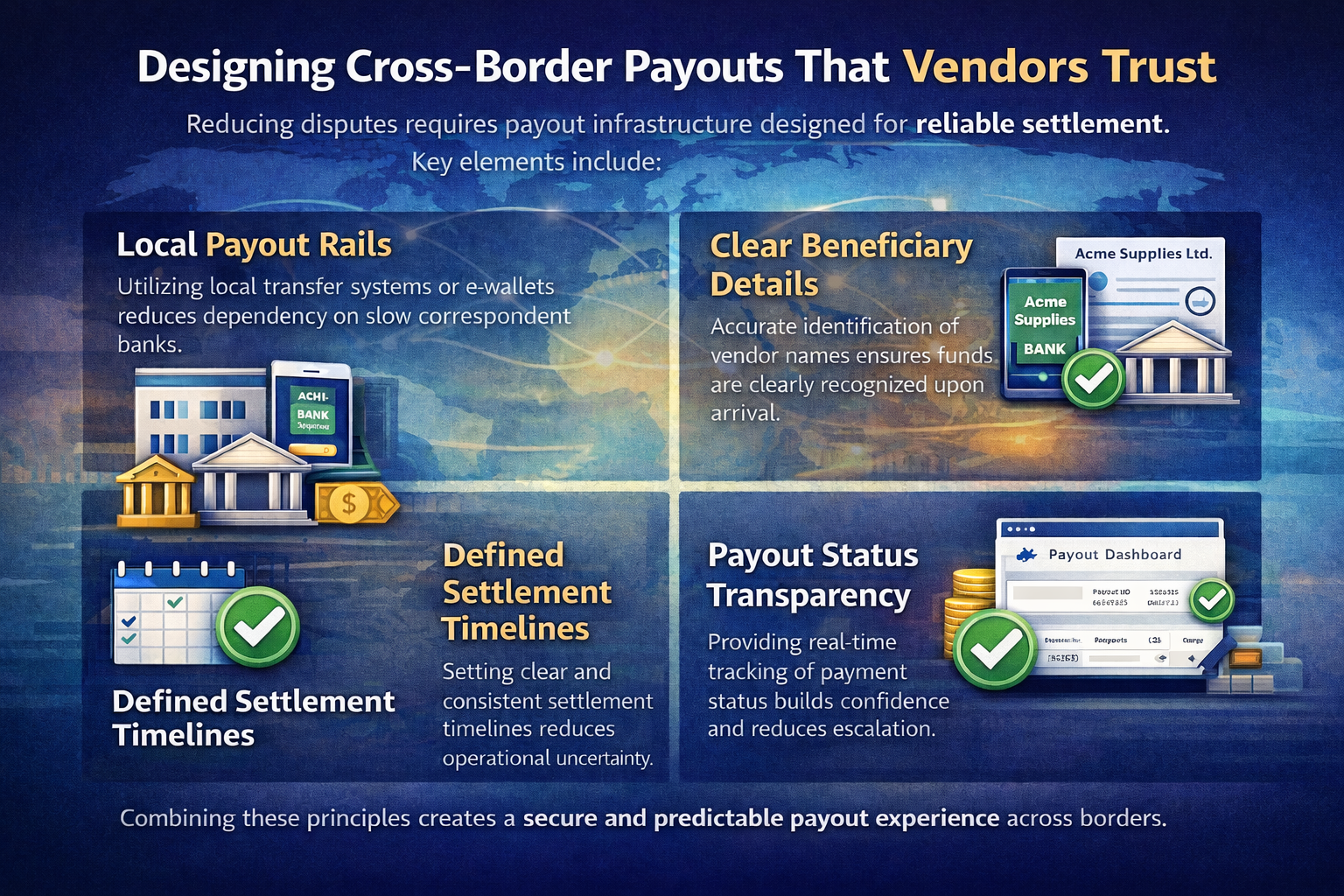
Reducing disputes requires payout infrastructure designed for settlement certainty. Effective designs typically include the following elements:
Where available, routing payouts through local bank transfers, e-wallets or domestic payment methods reduces reliance on correspondent banking networks. Local rails generally offer clearer settlement timelines, lower variability, and greater familiarity for recipients.
Accurate and recognisable beneficiary naming ensures vendors can immediately identify incoming funds, reducing confusion and unnecessary follow-ups.
Clear and consistent settlement expectations enable vendors to plan operations confidently and reduce the need for defensive buffers.
Visibility into payout status allows finance and operations teams to communicate accurately with vendors, preventing speculation and escalation when delays occur.
Together, these elements transform payouts from a source of uncertainty into a predictable operational process.
Modern payout infrastructure addresses these challenges by combining cross-border orchestration with local payout rails across multiple markets.
Tazapay enable businesses to route payouts through appropriate local rails or ewallets where available, achieving instant or same-day settlement in many corridors. By integrating payouts with broader money movement capabilities such as collections and balances, payouts become part of a designed end-to-end flow rather than a fragmented final step.
This approach improves settlement predictability, reduces operational ambiguity, and allows businesses to manage vendor payouts with greater confidence.
Cross-border payouts are often evaluated primarily on pricing. While cost efficiency is important, it provides an incomplete view of payout performance.
A lower-cost payout that introduces settlement variability and disputes may ultimately be more expensive once operational overhead, vendor friction, and internal escalation costs are considered.
A more effective evaluation framework considers:
By prioritising these factors, businesses can align payout design with broader operational and supplier management objectives.
Vendor disputes in cross-border business are frequently symptoms of payout uncertainty rather than contractual disagreement or operational failure.
By improving payout speed and, critically, payout predictability, businesses can reduce disputes, strengthen vendor relationships, and improve supply chain reliability. This requires moving beyond traditional correspondent banking models and adopting payout infrastructure designed for consistency, visibility, and local settlement.
Cross-border payouts should therefore be treated as a strategic component of vendor reliability, not merely a back-office function.

Expanding globally isn’t only about finding new customers. It’s also about how easily you can pay the people who keep your business running — sellers, vendors, suppliers, and partners around the world. For B2B companies, payouts are one of the most important parts of building trust and keeping relationships strong.
The challenge is that many businesses still face high fees, banking delays, and a lack of visibility when sending money across borders. The good news is that smarter payout methods are now making it possible to cut costs while giving sellers and vendors a smoother, more reliable experience.
International payouts have long been weighed down by inefficiencies. SWIFT and wire transfers often move through several banks before reaching the final recipient, and each step adds fees. Foreign exchange spreads can also reduce the final amount received. When you’re sending payouts at scale, these costs add up quickly.
For sellers, vendors, and suppliers, payouts are more than just transactions — they’re a sign of trust in the company they work with. When payments are late or unclear, confidence in that relationship weakens. Common frustrations include:
Companies that solve these problems don’t just save costs; they build stronger, more reliable relationships with their global network of sellers and vendors.
.png)
The most common ways businesses send cross-border payouts today are through local bank transfers and SWIFT or wire transfers. Alongside these, newer options like stablecoin-to-fiat payouts are helping businesses remove banking delays and avoid extra costs.
Local bank transfers
By working with licensed partners in each country, payouts can move directly through local banking networks. This usually means lower transaction fees, faster settlement times, and fewer surprises for the recipient subject to the local bank’s cut-off time.
SWIFT and wire transfers
SWIFT and wires remain the backbone of many international payouts. They’re secure and widely accepted, especially for corridors where no local alternative exists with the option of sending out large payments. While they can take longer and involve more fees than local transfers, costs can be reduced by using payout providers that optimize routes and minimize intermediary bank charges.
Stablecoin to fiat payouts
Smarter payout methods are also emerging. Stablecoins allow value to move almost instantly, without the usual banking delays or intermediary deductions. With the right infrastructure, they can be converted directly into any supported local currency, so sellers and vendors always receive fiat in their accounts. Tazapay supports this flow, giving businesses more flexibility while reducing unnecessary costs and delays.*
Reducing costs is important, but speed and reliability matter even more to sellers and vendors. A strong payout experience usually comes down to:
Managing payouts across multiple countries and currencies isn’t simple. It requires more than just moving money — it calls for compliance, automation, and a partner that can handle scale.
Tazapay brings all of this together. We support local bank transfers, SWIFT/wire transfers, and stablecoin-to-fiat payouts, all managed through a single dashboard. Businesses gain efficiency and compliance, while sellers, vendors, and suppliers receive a reliable experience they can count on.
Cross-border payouts are no longer just an operational detail. They directly shape how sellers, vendors, and suppliers see your company and whether they continue working with you. By combining local bank transfers, SWIFT, and smarter options like stablecoin-to-fiat, businesses can reduce costs, avoid unnecessary delays, and deliver a payout experience that grows with them.
👉 Learn more about Payouts with Tazapay and how we help businesses streamline global payouts at scale.
*Stablecoin services are offered through Tazapay Canada Corp.
Expanding into Vietnam or paying vendors, partners, or freelancers there—and facing frequent payout failures or delays? You’re not alone. Vietnam is rapidly emerging as a preferred market for eCommerce sellers, SaaS providers, gig platforms, marketing agencies, and more. But for many global businesses, cross-border payouts to Vietnam are still a major bottleneck due to high failure rates, long settlement times, and compliance hurdles.
In this blog, we’ll break down why payment failures happen, and how to streamline your payouts to Vietnam for faster, compliant, and more reliable delivery.
1. Incorrect or Incomplete Beneficiary Information
Vietnamese banks require exact name matching, including diacritics (accents) and full legal names. A minor mismatch—like "Nguyen Thi A" vs. "Nguyễn Thị A"—can result in automatic rejection. Real-time name validation at the point of entry helps prevent these avoidable errors.
2. Regulatory Compliance Issues
Payments that don’t specify the correct purpose codes or lack required documentation often trigger delays or rejections due to Vietnam’s strict FX and AML controls. Ensuring you collect and apply the proper codes from the start is essential to pass compliance checks smoothly.
3. Unsupported Payment Methods
Transfers relying only on SWIFT or traditional international wires are slower, more expensive, and prone to failure, especially without integration into local banking systems. Leveraging local payout rails can drastically reduce latency and increase success rates.
4. Outdated Banking Infrastructure
Not all Vietnamese banks are fully equipped to handle international transfers efficiently. Delays and errors can stem from a lack of proper routing or settlement systems. Aligning with banks or systems that are integrated into local clearing mechanisms improves reliability.
Industries where frequent or high-volume payouts are critical include:
1. Use a Payout Partner With Local Rails
Avoid relying solely on SWIFT or international wires. Instead, utilize a global payment platform that integrates directly with Vietnamese banks through local payout rails.
2. Automated Name Validation
Choose a provider that offers real-time name matching and validation before transfer. This significantly reduces failure rates due to naming mismatches.
3. Pre-Check Bank Code Formats
Vietnamese banks require accurate branch codes and identifiers. Your provider should offer automated name validation tools to detect errors before submission.
4. Support for Payment Purpose Codes
Ensure your payout provider collects and applies the correct purpose codes and business justifications as mandated by Vietnamese regulations.
5. Faster Settlement & Retry Handling
Select a partner that supports same-day or next-day payouts and has a failover mechanism, ensuring that if one bank fails, the payment can be retried automatically without manual intervention.
For businesses running digital campaigns, relying on freelancer output, or managing cross-border vendors, fast and error-free payouts can mean the difference between profit and loss. Payment friction leads to lost opportunities, eroded trust, and diminished operational efficiency.
Tazapay enables businesses to send compliant, fast, and reliable payouts to Vietnam with:
If you’re scaling into Vietnam, don’t let broken payouts slow you down. The right payout partner—one with local rails, automation, and compliance built in—can help you eliminate failed transfers, boost partner trust, and pay faster in VND with confidence.
Vietnam is one of Southeast Asia’s fastest-growing digital economies and a strategic market for global companies working with freelancers, vendors, sellers, or gig workers. Whether you're managing payouts from a platform, disbursing partner earnings, or running contractor payments, getting money into Vietnam reliably is a must.
Yet many businesses run into avoidable payout failures due to nuances in Vietnam’s banking infrastructure. These issues can lead to delays, increased support costs, and recipient frustration—especially at scale.
This guide covers the most common payout challenges when sending funds to Vietnam—and how to prevent them with the right infrastructure and partners.
Vietnam’s financial system is localised, and some processes differ from global norms. Common pain points include:
For global companies, missing even one of these details can break an otherwise routine payout.
Banks in Vietnam require the beneficiary name to match exactly what's on record—including accents and special characters. For example, "Nguyen Van Hoa" may be rejected if the official name is “Nguyễn Văn Hòa”.
Avoid it by:
Bank identifiers in Vietnam vary by branch. Using a generic SWIFT code or skipping the full code can cause payment rejection or misrouting.
Avoid it by:
Not all banks in Vietnam fully support SWIFT transfers, and some transactions require manual handling.
Avoid it by:
Vietnamese regulators require a clear reason for each cross-border payment. Missing or unclear codes can lead to rejections or compliance flags.
Avoid it by:
Many Vietnamese accounts accept only VND. Sending USD can trigger forced conversions with unfavorable rates and hidden fees.
Avoid it by:
If you’re making dozens—or thousands—of payouts into Vietnam each month, even a 1–2% error rate can create:
When scaled across geographies and recurring cycles, these small frictions can become major blockers to growth—for platforms, SaaS companies, digital agencies, marketplaces, fintechs, gig economy platforms, and more.
To manage payouts into Vietnam smoothly and sustainably, global businesses should look for solutions that offer:
This is where payment solutions like Tazapay come in. By combining local bank integrations, automated beneficiary name validation checks, VND payout capability, and full compliance support, Tazapay simplifies what’s otherwise a complex payout environment.
Whether you're disbursing to a handful of contractors or running hundreds of seller withdrawals per week, Tazapay helps you avoid costly errors—without needing to build out a local infrastructure yourself.
Scaling in Vietnam? Payments are the operational foundation of that growth.
Getting payouts wrong adds friction and risk. Getting them right builds trust, speeds up operations, and improves your brand experience.
Avoid the common pitfalls. Streamline your Vietnam payouts with infrastructure that’s purpose-built for global businesses—like Tazapay.


