
Every stablecoin payment passes through five parts of a stack: the issuer, the settlement chain, the network layer, licensed providers and local rails. This glossary groups each term under the part of the stack where you are most likely to meet it. For deeper reading on stablecoin settlement, treasury, emerging market corridors and the infrastructure behind them, Tazapay's payment and stablecoin guides cover each topic in full.
Stablecoin. A digital token designed to hold a steady value, usually pegged one to one to a currency such as the US dollar. There are several types of stablecoins, but fiat-backed coins dominate business payments.
Issuer. The company that creates a stablecoin and stands behind its value. Circle, for example, issues USDC and EURC.
Reserves. The cash and short-term assets an issuer holds to back the stablecoins in circulation. For a fiat-backed stablecoin, reserves are what make one token worth one dollar.
Attestation. A regular report from an independent accounting firm confirming that an issuer's reserves match or exceed the tokens in circulation. Treasury and compliance teams use attestations to judge issuer quality.
Mint and burn. Minting creates new stablecoins when money is deposited with the issuer. Burning destroys them when they are redeemed. Supply rises and falls with demand through these two actions.
Redemption. Exchanging stablecoins with the issuer for the underlying currency. Fast, reliable redemption is what keeps a stablecoin at its peg.
Peg and depeg. The peg is the fixed value a stablecoin aims to hold, such as one US dollar. A depeg is when the market price moves away from that value, usually because of doubts about reserves or redemption.
Layer 1. A base blockchain that records and finalizes transactions on its own, such as Ethereum or Solana. Ethereum's documentation describes layer 1 chains as the foundation other projects build on.
Layer 2. A separate blockchain that runs on top of a layer 1 and relies on it for security. Layer 2 networks usually offer lower fees and faster confirmations. Our guide to layer 1 and layer 2 blockchains for payments explains how both fit into a stablecoin payment.
Rollup. The most common type of layer 2. It bundles many transactions into one transaction on the base chain, so the fee is shared and each payment costs less.
Payment blockchain. A layer 1 blockchain built specifically for stablecoin payments. Payment blockchains usually price network fees in stablecoins and aim for very fast finality. Arc, from Circle, is one example. We compare the main ones in what payment blockchains are and how they differ.
General-purpose chain. A blockchain designed to run any kind of application, from trading to games. Payments compete with all other activity for space, so fees can rise with demand.
Validator. An operator that checks transactions and adds them to the chain. On a permissioned chain, validators are a known, approved group. On a permissionless chain, anyone meeting the technical rules can take part.
Consensus. The method validators use to agree on the order and validity of transactions. Different consensus designs trade off speed, openness and resilience.
Finality. The point after which a transaction cannot be reversed. Deterministic finality means a transaction is final as soon as it is confirmed, with no later reordering.
Gas. The fee paid to the network to process a transaction. On many chains gas is paid in the chain's own token. On payment-focused chains such as Arc, it is paid in USDC.
EVM compatibility. The ability to run software written for the Ethereum Virtual Machine. EVM-compatible chains let developers use familiar Ethereum tools.
Smart contract. Code deployed on a blockchain that runs automatically when set conditions are met. Stablecoins themselves are smart contracts.
Cross-chain transfer. Moving a stablecoin from one blockchain to another. Circle's Cross-Chain Transfer Protocol (CCTP) does this for USDC across supported chains.
Wallet. Software or hardware that holds the keys needed to send and receive digital assets. Businesses usually use custodial or multi-signature wallets rather than a single key.
Block explorer. A public website that shows transactions on a blockchain. Teams use explorers to confirm that a transfer has settled.
Onchain and offchain. Onchain activity is recorded on a blockchain. Offchain activity, such as a bank transfer or a compliance check, happens outside it. Most business payments mix both.
Payment network. A set of rules and messaging that lets licensed institutions send payments to each other. In stablecoin payments, the network coordinates and the blockchain settles.
Originating Financial Institution (OFI). The institution that starts a payment for the sender. It verifies the customer, converts local currency into stablecoins and sends them.
Beneficiary Financial Institution (BFI). The institution that receives a payment for the recipient. It converts stablecoins into local currency and pays out.
Counterparty directory. The list of vetted institutions a network member can send to. It replaces the need for a separate agreement with every partner.
Payment versus payment (PvP). A settlement method where two currency legs of a trade settle at the same moment, so neither side is exposed if the other fails. Arc's FX engine is designed for onchain PvP settlement between stablecoins.
Travel Rule. The name used for FATF Recommendation 16 when it applies to virtual assets. It requires sender and recipient information to travel with a transfer. FATF revised the standard in June 2025, with the changes due to take effect by the end of 2030.
On-ramp. Converting local currency into stablecoins. In a business payment, this is usually done by the sending institution.
Off-ramp. Converting stablecoins back into local currency. Off-ramp depth, or how much can be converted at a fair rate, varies widely by market and matters most in emerging market corridors.
Fiat in, stablecoin across, fiat out. The most common business model for stablecoin payments, where neither sender nor recipient holds stablecoins. The stablecoin sandwich model works through this flow step by step.
KYB. Know Your Business checks that verify a company's identity, ownership and activity before it can send or receive payments.
Custody. Holding and safeguarding digital assets on behalf of a customer. Custody can be run in-house or outsourced to a specialist.
VASP. A virtual asset service provider, the term regulators use for firms that exchange, transfer or hold digital assets for others.
MSB. A money services business, a registration category used in countries such as Canada and the United States for firms that transmit or exchange money.
These are general payment terms that matter for stablecoin flows. Our full payments glossary covers them alongside collections, FX and compliance terms.
Local rail. A domestic payment system that delivers funds to a bank account or wallet in a given country. The local rail often decides when a recipient actually sees the money.
Correspondent bank. A bank that holds accounts for other banks and processes cross-border payments for them. A single payment can pass through several correspondents.
Nostro account. An account a bank or payment company holds with another bank in a foreign currency, used to pay out in that market.
Prefunding. Placing money in payout accounts in advance so payments can go out quickly. Faster settlement between institutions can reduce how much prefunding a business needs. How much this matters depends on your model, as the pros and cons of stablecoin rails for fintechs show.
FX spread. The gap between the rate a provider gives you and the market rate. In stablecoin payments, the spread at the off-ramp is often the largest single cost.
Settlement time and payout time. Settlement time is when funds are final between institutions. Payout time is when the recipient can use them. A payment can settle onchain in seconds and still wait for a local cut-off.
Most stablecoin business cases describe a large supplier payment into an emerging market, where a percentage saving on a six-figure invoice makes the arithmetic obvious. That case is real, but it is not the one most finance teams deal with monthly.
Operating expenses are. A company headquartered in one country runs on software licensed in a second, cloud capacity billed in a third, contractors in a fourth, and an office with rent and utilities in a fifth. None of those invoices is large. All of them are regular, dated, and denominated in a currency the company does not hold. EY-Parthenon's post-GENIUS Act survey found that 77 percent of corporate stablecoin users cite supplier payments as their primary use case, and that 41 percent reported cost savings of at least 10 percent [1]. The operating-expense slice of that spend is the part nobody models, because each individual payment looks too small to bother with.
It is worth bothering with, for reasons that have little to do with the size of any single payment.
The category is broader than most teams assume once they list it out.
Software and cloud. Licences, seats and infrastructure billed by vendors incorporated elsewhere, usually in dollars, usually monthly, usually on a fixed date.
Contractors and freelancers. Developers, designers, analysts and agencies engaged in other countries, invoicing in their own currency or in dollars, expecting payment within days rather than weeks.
Premises and utilities. Rent, serviced-office fees, power and connectivity for a local presence in a market where the company has no entity and no local bank account.
Local professional services. Accountants, legal counsel, compliance advisors and filing agents retained in each market the company operates in.
Platform and marketplace fees. Advertising spend, app-store commissions, listing fees and other charges deducted or invoiced by platforms based abroad.
What unites them is not the amount. It is the shape: low value, high frequency, hard deadline, wrong currency.
Cross-border cost does not scale down neatly. A wire carries a sending fee, intermediary deductions along the correspondent chain, a receiving fee at the far end, and an FX spread buried in the rate. Several of those are close to fixed, so on a small payment they stop being a percentage and start being a tax. The World Bank's data puts the global average cost of sending money across borders at around 6 percent, with banks the most expensive channel at close to 15 percent [2]. Those figures cover remittances rather than corporate treasury, and enterprise pricing is better, but the direction holds: the smaller the payment, the worse the ratio.
Frequency compounds it. A payment made once is an annoyance. The same payment made every month, across eight currencies, is a standing line item plus the operational cost of initiating, chasing and reconciling each one. And because these bills carry hard dates, a two or three day settlement window forces teams to pay early, which means holding balances in currencies they would rather not hold, or accepting the risk that a vendor suspends service over a payment that was sent on time but landed late.
Prefunding is the hidden cost underneath all of this. To pay reliably in eight currencies you hold balances in eight currencies, sized for the worst case and sitting idle the rest of the month. That is working capital doing nothing, exposed to the FX moves you were trying to avoid in the first place.
The important thing to understand is that your payee almost certainly still receives local fiat. A landlord in Manila, a utility company in Berlin and a contractor in São Paulo are not going to invoice in USDC or accept it, and they do not need to. The stablecoin leg is internal to the payment, not something the recipient sees.
The mechanism is the same one covered in depth in our stablecoin payments guide for global businesses: the company funds a payment in USDC, the provider moves that value across the settlement layer in minutes rather than days, and the destination leg converts to local currency and pays into the recipient's ordinary bank account. What changes is the middle. The correspondent chain, where the intermediary deductions and the multi-day wait live, is the part that gets removed.
Two consequences matter for operating expenses specifically. First, funding happens per payment rather than per currency, so the idle balances across eight markets are released back into the business. Second, because the settlement window collapses from days to minutes, payments can be initiated close to the due date instead of days ahead, which is the difference between paying on time and paying early to be safe.
The Federal Reserve's analysis is a useful corrective on where the cost actually sits: moving the stablecoin itself is close to free, and the real cost structure lives at the on-ramp and off-ramp, shaped by regulation, liquidity depth and how competitive the provider market is in each destination [3]. So the saving is genuine but it is not unlimited, and it varies sharply by market. A euro payment is not where this shines. A payment into a currency where banking rails are slow and the FX spread is wide is.
Four limits matter.
Accounting treatment is unsettled. Stablecoins fall outside the scope of the fair-value rules introduced by FASB ASU 2023-08, because a fiat-backed token carries a redemption right against the issuer's reserves and therefore represents an enforceable claim. That leaves classification to judgement, somewhere between cash equivalents, financial instruments and intangible assets, and US GAAP does not yet give a definitive answer [4]. Agree the treatment with your auditor and write it into policy before the first payment, not after the first audit question.
Holding is not the point. Under the GENIUS Act, issuers of payment stablecoins cannot pay yield simply for holding a balance [5]. There is no treasury return to chase here. Value comes from settlement speed and released working capital, and a balance held longer than it needs to be is just an unhedged dollar position.
Not every market is worth it. Where local rails are already fast and cheap, the gain is marginal. The honest test is corridor by corridor, not company-wide.
It is a payment method, not a policy. Approval thresholds, who can initiate, how counterparties are verified and how the whole thing reconciles into the ledger still have to be designed. The treasury-side controls are covered in our CFO implementation guide.
Operating expenses are a good first use case precisely because they are unglamorous. The amounts are small enough to pilot without board-level risk, the payments repeat every month so you get a clean read on cost and settlement time within one cycle, and the counterparties are ones you already know and have already onboarded.
A provider handling this properly gives you stablecoin settlement into local payout rails, so the USDC leg is internal and the recipient is paid in their own currency into their own bank account, with the funding, conversion and payout visible in one place rather than reconstructed from three systems. Start with the two or three markets where your bank rails are slowest and the spread is widest, run a month of real bills through them, and compare the landed cost and the settlement time against the same payments a month earlier. That comparison, on your own corridors and your own volumes, is a more useful answer than any industry average.
[1] EY-Parthenon. "Cost Savings and Speed Drive Stablecoin Adoption." 2025.
[2] World Bank. "Remittance Prices Worldwide, Issue 54." September 2025.
[3] Federal Reserve Board. "Payment Stablecoins and Cross-Border Payments." FEDS Notes, March 2026.
[4] Forvis Mazars. "Accounting for Stablecoins: Navigating Uncertainty Within US GAAP." November 2025.
[5] K&L Gates. "Crypto in 2026: The Democratization of Digital Assets." January 2026.

Two problems follow cross-border businesses everywhere, and they're worst in emerging markets. Getting hold of dollars when the banking system makes them scarce, slow, or expensive. And currency risk, where value earned in a volatile local currency erodes between the moment it lands and the moment it converts. Stablecoins have become a practical tool for both, which is why businesses on the toughest corridors keep reaching for them.
Here's how stablecoins reduce cross-border costs and manage liquidity and currency risk, and where the limits are.
In a lot of markets, getting dollars is not as simple as asking a bank. Access is limited by local rules, thin correspondent relationships, queues, and cost. So a business that earns in a local currency but owes dollars can wait, and pay a premium, to get the hard currency it needs.
A dollar-referenced stablecoin gives another route to USD value. It's designed to hold a one-to-one value with the dollar, and it moves on rails that are always on. So a business can reach and move dollar-denominated value without depending on a local bank's dollar liquidity in that moment. On a corridor where dollars are genuinely hard to source, that access is the whole point. This is not speculation. It's reaching liquidity the local system cannot reliably provide.
Currency risk is the quieter cost. A business that takes in local currency and can't convert it right away is exposed to whatever the rate does in the meantime. In a volatile or steadily weakening market, that's a real, repeated loss, not a rounding error. The gap between earning and converting is a window where value leaks out.
Holding value in a dollar-referenced stablecoin narrows that window. Instead of sitting in a currency that may weaken, the business holds a stable, dollar-linked unit until it chooses to convert or spend.
Faster settlement compounds the benefit, and this is where a lot of the cost reduction comes from. Because stablecoin transfers settle in a short window rather than over days of correspondent banking, the time a payment spends exposed to a moving rate shrinks. Less time in transit, less exposure to the rate turning against you, and fewer intermediary hands taking a cut along the way. The mechanism that collapses that settlement chain is covered in our stablecoin settlement guide, and the corridor-level view in our guide to stablecoins in emerging markets.
This is why the same logic lands hardest for financial institutions. An institution moving high volumes across correspondent chains pays for every hop and every day in transit. Shortening the chain and the settlement time is where stablecoins reduce transaction costs at the institutional scale, not by shaving a fee here and there, but by removing links from the chain.
The scale is no longer marginal. The Bank for International Settlements has estimated roughly 400 billion dollars was settled via stablecoins in 2025 across consumer and commercial flows, a sign businesses are using them for real money movement, not speculation [1].
Stablecoins are a tool, not a cure, and being honest about the limits is part of using them well.
A stablecoin is only as sound as its issuer and its reserves, so the choice of stablecoin matters, and regulation increasingly separates compliant issuers from non-compliant ones. Moving between local currency and stablecoin still involves conversion at each end, with its own cost and its own moment of FX. And the regulatory treatment varies by market, so a business has to work with a provider whose permissions it can verify.
None of this erases the benefit on corridors where liquidity is genuinely tight and the local currency genuinely volatile. It just means stablecoins should be chosen deliberately, for the corridors where they earn their place, not switched on everywhere by default.
The pattern is selective. On stable, well-served corridors, local rails and conventional FX are still efficient. On the corridors where dollars are hard to source and the local currency erodes value, stablecoins hit both problems at once: access to liquidity, and a shield against volatility, with settlement fast enough to keep FX exposure and cost down. Used that way, through a provider whose stablecoin services are properly authorised, they're one of the more effective tools a business has for its hardest markets.
Liquidity constraints and currency swings are old problems. For a long time, businesses had few tools to manage them on difficult corridors. Stablecoins are one of the first that genuinely helps with both at once, which is exactly why their use in commercial cross-border flows has grown so fast, and fastest where the old tools worked least well.
[1] Bank for International Settlements, via InternationalMoneyTransfer.com. "Money Transfer Statistics 2025." February 2026.
[2] World Bank. "Remittance Prices Worldwide." 2026.

Stablecoin regulation changed character between 2024 and 2026. What were previously proposals became enacted statutes under active enforcement across multiple jurisdictions [8]. Stablecoins are now regulated under dedicated law in the US, the EU, and Hong Kong, among others, and every major regime prohibits paying interest to holders [8][10].
Despite differences in structure, the major frameworks converge on a common set of principles [8]:
The result is not a single global rulebook. It is a set of jurisdiction-specific frameworks that share a common foundation, which means the compliance status of a given stablecoin depends on the jurisdictions a payment touches [8].
The GENIUS Act was signed into law on July 18, 2025 as Public Law 119-27, establishing the first US federal framework for payment stablecoins [1]. It restricts issuance to permitted payment stablecoin issuers and sets requirements including one-to-one reserve backing in cash and short-dated Treasuries, monthly reserve disclosures, AML and sanctions compliance, holder protections, and a prohibition on yield-bearing payment stablecoins [1][2].
The Act's implementing rules were still being written through 2026. Federal regulators issued ten notices of proposed rulemaking but did not finalise them by the statutory deadline of July 18, 2026. The Act's effective date is set as the earlier of 18 months after enactment, meaning January 18, 2027, or 120 days after final rules are issued; because final rules were not issued by the anniversary, the January 18, 2027 date applies [2]. Our blog on the GENIUS Act at one year covers the rulemaking status in detail.
The Act also divides supervision by issuer size. Issuers with consolidated outstanding issuance of not more than ten billion dollars may opt for state-level supervision where the state regime is substantially similar to the federal framework [2].
The EU Markets in Crypto-Assets Regulation (MiCA) became fully applicable on December 30, 2024, and its transition period for crypto-asset service providers ended on July 1, 2026 with no extension [3]. After that date, any provider serving EU clients without MiCA authorization is in breach of EU law [3][4].
MiCA divides public stablecoins into two categories [5]:
Under MiCA, tokens must be backed one-to-one by liquid assets and be redeemable at par at any time, and issuers may not pay interest on EMTs or ARTs [5][8]. A practical consequence of the July 2026 deadline was that USDT was delisted across EEA-regulated venues, because Tether did not apply for EMT authorization, while Circle's USDC and EURC retained their listings under Circle's EU authorization [4]. Our blog on MiCA after July 2026 covers what changed at the deadline.
MiCA also continues to be refined through delegated acts and technical standards developed by the European Commission, ESMA and the European Banking Authority [8]. One such development, an EBA opinion published in February 2026, clarified that transferring an e-money token can qualify as a payment service under the second Payment Services Directive, because an EMT is legally a form of electronic money.
Several jurisdictions outside the US and EU have moved from experimentation to active supervision.
Hong Kong brought its Stablecoins Ordinance into effect on 1 August 2025 and granted its first stablecoin issuer licences in 2026 [7]. The regime applies to issuers of fiat-referenced stablecoins in Hong Kong, and to issuers of Hong Kong dollar-referenced stablecoins even where issued outside Hong Kong [7].
Singapore operates its stablecoin framework under the Monetary Authority of Singapore, applying to single-currency stablecoins pegged to the Singapore dollar or a G10 currency and issued in Singapore, with a requirement that reserves be held at no less than 100% of coins in circulation [6].
The UAE regulates fiat-backed payment tokens at the federal level under the Central Bank of the UAE's Payment Token Services Regulation, effective from August 2024 [8].
Japan regulates fiat-backed stablecoins as electronic payment instruments under amendments to its Payment Services Act, effective from June 2023 [8].
Across these regimes, the shared principles hold: licensing of issuers under financial supervision, one-to-one reserve backing, redemption at par, and AML and KYC controls [8].
Beyond issuer requirements, stablecoin transfers are subject to transfer-level AML compliance under what is commonly called the Travel Rule.
The Travel Rule requires issuers and payment providers to collect and share sender and recipient information for qualifying transfers, applying the same standard used for traditional wire transfers [9]. This is an obligation on the entities facilitating the transfer rather than on the underlying token. Our blog on the Travel Rule for cross-border payments covers how it applies to businesses in practice.
The Travel Rule has been widely adopted. In its 2026 targeted update, the FATF reported that 83% of surveyed jurisdictions had passed legislation implementing the Travel Rule, up from 73% (85 of 117) in 2025, with a further group of jurisdictions reporting implementation under way [9]. In the EU, the Transfer of Funds Regulation implements this requirement for crypto transfers [8].
For a business considering stablecoin settlement, the practical question is which obligations fall on the business itself and which fall elsewhere.
Stablecoin regulation is primarily issuer-led: the substantive requirements on reserves, redemption, governance, disclosures and supervision apply to the entity issuing the stablecoin [8]. Service-provider requirements, including licensing and Travel Rule compliance, apply to the regulated intermediaries that move the tokens [9].
A business that uses a licensed provider's stablecoin settlement infrastructure, rather than holding or converting stablecoins itself, generally faces the same obligations as it would for any cross-border payment: KYC and KYB on its counterparties, sanctions screening, and transaction monitoring. The stablecoin-specific compliance, meaning the Travel Rule at the transfer layer, the GENIUS Act issuer requirements, and the MiCA EMT rules, is handled by the provider and the stablecoin issuer [8].
This division is why the choice of provider and the choice of stablecoin matter. The compliance status of the specific stablecoin in a payment flow depends on both the issuer's authorizations and the jurisdictions the payment touches, and a given token may be authorized in one jurisdiction and unavailable on regulated venues in another [4][8].
Because the major frameworks are jurisdiction-specific, a stablecoin or provider operating across borders is subject to more than one at once. The frameworks share core principles but differ in detail, and in some areas the details diverge, for example in the specific reserve composition each regime requires [8].
Reserve and redemption rules are converging across jurisdictions toward one-to-one high-quality reserves and redemption at par [8]. AML and sanctions requirements are also tightening across regimes [9]. The direction of travel is toward greater alignment on principles, with implementation detail remaining jurisdiction-specific [8].
For a comparison of how the US, EU, Canada, Hong Kong and Singapore payment and digital-asset frameworks fit together, see our global payment licensing landscape guide. For how stablecoin settlement works operationally, see our complete guide to stablecoin payments.
[1] U.S. Congress. "S.1582 - Guiding and Establishing National Innovation for U.S. Stablecoins (GENIUS) Act, 119th Congress (Public Law 119-27)." Signed July 18, 2025.
[2] Congressional Research Service. "Stablecoin Legislation: An Overview of S. 1582, GENIUS Act of 2025." Congress.gov.
[3] European Securities and Markets Authority (ESMA). "Statement on the end of transitional periods under MiCA." 17 April 2026.
[4] European Securities and Markets Authority (ESMA). "Public Statement: ESMA calls on unauthorised crypto-asset service providers to cease services as the MiCA transitional period ends." 23 June 2026.
[5] European Securities and Markets Authority (ESMA). "Markets in Crypto-Assets Regulation (MiCA)."
[6] Monetary Authority of Singapore. "MAS Finalises Stablecoin Regulatory Framework." 15 August 2023.
[7] Hong Kong Monetary Authority. "Regulatory Regime for Stablecoin Issuers" (Stablecoins Ordinance, effective 1 August 2025).
[8] EY. "Global stablecoin regulation: a comparison of frameworks." September 2025.
[9] Financial Action Task Force (FATF). "Targeted Update on Implementation of the FATF Standards on Virtual Assets and VASPs" (seventh update). July 2026.
[10] BVNK. "Global stablecoin regulations 2026: What enterprises need to know." January 2026.
.png)
The GENIUS Act, Public Law 119-27, was signed on July 18, 2025. Section 13 required the primary federal payment stablecoin regulators to promulgate implementing regulations within one year of enactment, setting a deadline of July 18, 2026 [1].
As of that date, ten notices of proposed rulemaking had been issued across the federal agencies. None had been finalised [1][2]. Several comment periods remained open past the deadline [1].
A notice of proposed rulemaking is a draft rule issued for public comment. It is not binding, and its provisions may change before a final rule is adopted.
Rulemaking responsibility under the GENIUS Act is distributed across Treasury and the federal banking agencies, with FinCEN and OFAC covering anti-money laundering and sanctions requirements.
The OCC proposal. Issued February 25, 2026, the OCC's notice of proposed rulemaking addresses the regulations the OCC is required to promulgate under the GENIUS Act other than those relating to the Bank Secrecy Act, anti-money laundering and sanctions [4]. The majority of the proposed rules would sit in a new 12 CFR Part 15, covering standards for reserves, redemption, capital, liquidity, risk management and reporting. The proposal also revises capital adequacy standards in 12 CFR 3, prompt corrective action regulations in 12 CFR 6, assessment of fees in 12 CFR 8, and rules of practice and procedure in 12 CFR 19 [4]. The Conference of State Bank Supervisors noted that the proposal asked over 200 questions [3]. The OCC issued a separate proposal covering Bank Secrecy Act and sanctions compliance standards on June 22, 2026 [5].
The Treasury state regime proposal. Announced April 1, 2026 and published in the Federal Register on April 3, this was Treasury's first proposed regulation under the GENIUS Act, with comments due June 2, 2026 [6][7]. Under the Act, payment stablecoin issuers with consolidated total outstanding issuance of not more than ten billion dollars may opt for regulation under a state-level regime, provided that regime is substantially similar to the federal framework [6]. The proposal sets out the principles Treasury would apply in making that determination.
The proposal uses the OCC's proposed implementation rule as a reference point for prudential expectations. On reserves, Treasury proposes that states may permit reserve assets beyond those listed in Section 4(a)(1)(A) only where the OCC has approved those assets as similarly liquid federal government-issued assets under Section 4(a)(1)(A)(vii). Under the proposal, states may be more conservative than the OCC but not more permissive [8]. Treasury also proposes that the definition of the federal regulatory framework include relevant implementing rules and interpretations rather than the statutory text alone [8].
Earlier Treasury activity. Treasury issued an advance notice of proposed rulemaking on September 19, 2025, seeking comment on temporary safe harbours, clarification of statutory terms, methods for detecting illicit activity, evaluation of whether foreign stablecoin regimes are comparable to the GENIUS Act regime, and tax and insurance implications [9][10]. In March 2026, Treasury issued a report to Congress covering its findings on technologies to counter illicit finance involving digital assets [9].
Section 16 provides that the Act takes effect on the earlier of two dates: 18 months after enactment, which is January 18, 2027, or 120 days after the date on which the primary federal payment stablecoin regulators issue any final regulations implementing the Act [11].
Because final regulations were not issued by the one-year mark, the first of those two dates applies. The Act takes effect on January 18, 2027 [1][2].
The January 18, 2027 date is fixed by reference to the enactment date and does not shift if rulemaking continues past that point. The period between the issuance of final rules and the effective date is the interval available to issuers for implementation of reserve, custody, reporting and registration requirements [1].
Section 16 also requires the primary federal payment stablecoin regulators to notify Congress upon beginning to process applications under the Act [11].
Certain requirements are set by the statute itself and are not dependent on the outcome of rulemaking.
Issuers must hold reserves backing outstanding tokens on a one-to-one basis in cash, short-dated Treasuries and similar instruments, and must publish monthly disclosures of reserve composition. Issuers are prohibited from paying yield or interest to holders. Banks and credit unions may issue only through subsidiaries. Issuers with consolidated outstanding issuance of not more than ten billion dollars may elect state supervision where the state regime qualifies [6][12].
Matters that remain subject to pending rulemaking include which additional assets qualify under Section 4(a)(1)(A)(vii), the process by which state regimes will be certified as substantially similar, the application and approval process across each supervising agency, and the final form of anti-money laundering and sanctions programme requirements [3][9].
On July 13, 2026, the American Bankers Association and state banking groups submitted a request for clearer language on the Act's yield provisions and asked that rules prevent payment stablecoins from acting as deposit substitutes [2]. In January 2026, Bank of America chief executive Brian Moynihan stated that up to six trillion dollars in deposits, approximately one third of US commercial bank deposits, could shift to stablecoins if regulators were to permit yield payments on them [13].
During the 2026 legislative session, several states adopted legislation empowering their state banking or securities regulators to license and supervise stablecoin issuers in compliance with the GENIUS Act [3].
Two provisions of the Act address stablecoins issued outside the United States.
Section 15 addresses reciprocity. It directs the Federal Reserve, in collaboration with the Secretary of the Treasury, to create and implement reciprocal arrangements or other bilateral agreements between the United States and jurisdictions with substantially similar payment stablecoin regulatory regimes, for the purpose of facilitating international transactions and interoperability with United States dollar-denominated stablecoins issued overseas [11].
Treasury's September 2025 advance notice sought comment on how it should evaluate whether foreign regimes are comparable to the GENIUS Act regime [9][10]. In a comment letter submitted in November 2025, Circle recommended that recognition of foreign regimes require effective ongoing supervision rather than registration-only or light-touch models, and that criteria and determinations be published [14].
Section 8 addresses foreign issuer compliance. Under the Act, foreign issuers of payment stablecoins must comply with lawful orders. Where an issuer fails to do so, Treasury may designate the issuer as noncompliant, which results in a prohibition on digital asset service providers facilitating secondary market trading of that issuer's payment stablecoin. Treasury may issue licences and waivers, and is directed to specify the criteria a noncompliant foreign issuer must meet for Treasury to determine that it is no longer noncompliant [10].
Foreign issuer registration is one of the four proposals Treasury issued during the first year [2].
For a comparison of how the US framework sits alongside those in the EU, Canada, Hong Kong and Singapore, see our global payment licensing landscape guide.
The Federal Reserve reported aggregate stablecoin market capitalisation of 317 billion dollars as of April 6, 2026, representing more than 50% growth since early 2025. The same analysis noted that market capitalisation flattened during the final quarter of 2025 and the first quarter of 2026 [15]. At the one-year anniversary the market was reported at approximately 310 billion dollars, comprising roughly 184 billion dollars in USDT and 73 billion dollars in USDC [2].
Approximately 99% of stablecoin supply is denominated in US dollars [16].
On reserve composition, the Federal Reserve reported that according to attested disclosures, USDT maintains approximately 1.04 times reserves for each token in circulation, with approximately 0.74 times in assets qualifying as higher quality, defined as Treasuries, repurchase agreements backed by Treasuries, and bank deposits. USDC maintains full one-times backing in higher-quality reserves [15]. The same analysis reported that stablecoin transaction volumes on Ethereum rose by 50% following the GENIUS Act's enactment [15].
Aggregate stablecoin transfer volume for 2025 has been reported in the range of 28 to 62 trillion dollars depending on measurement methodology, of which an estimated 350 to 550 billion dollars represented real-economy payment activity, with the remainder representing trading and transfers between wallets and exchanges [16].
On institutional activity, JPMorgan has operated deposit tokens through its Kinexys platform since June 2025 and expanded to live payments for institutional clients in early 2026. That product is classified as a deposit token rather than a payment stablecoin under the GENIUS Act [13]. Bank of America, Citigroup and Wells Fargo explored a joint stablecoin project in 2025, and Wells Fargo separately piloted a digital cash token for internal settlement [13]. Tether launched USAT in January 2026 through Anchorage Digital [17].
On business adoption, an EY survey of 350 companies found that more than 50% of non-users planned to adopt stablecoins within six to twelve months, with cross-border payments cited as the primary intended use case [18]. Survey data reported by Reap identified lower transaction costs and faster cross-border payments as the leading stated reasons for adoption, and paying suppliers cross-border and accepting cross-border payments as the leading use cases [16].
For background on how stablecoin settlement operates, see our complete guide to stablecoin payments, and for the provisions of the Act as enacted, our earlier analysis of the GENIUS Act and cross-border payments.
[1] crypto.news. "The GENIUS Act turned one by missing its own deadline." July 2026. https://crypto.news/the-genius-act-turned-one-by-missing-its-own-deadline/
[2] GN Crypto. "U.S. Regulators Miss GENIUS Act Deadline for Stablecoin Rules." July 2026. https://www.gncrypto.news/news/us-regulators-miss-genius-act-deadline-stablecoin-rules/
[3] Conference of State Bank Supervisors. "A Look Back at One Year of GENIUS Implementation." July 2026. https://www.csbs.org/look-back-one-year-genius-implementation
[4] Office of the Comptroller of the Currency. "GENIUS Act Regulations: Notice of Proposed Rulemaking." Bulletin 2026-3. https://www.occ.gov/news-issuances/bulletins/2026/bulletin-2026-3.html
[5] Office of the Comptroller of the Currency. "GENIUS Act: Anti-Money Laundering/Countering the Financing of Terrorism and Sanctions Compliance: Notice of Proposed Rulemaking." Bulletin 2026-28, June 2026. https://www.occ.gov/news-issuances/bulletins/2026/bulletin-2026-28.html
[6] US Department of the Treasury. "Treasury Seeks Public Comment on GENIUS Act Notice of Proposed Rulemaking Concerning State-Level Regulatory Regimes." April 2026. https://home.treasury.gov/news/press-releases/sb0428
[7] Consumer Finance Monitor. "Treasury Issues NPRM on State Oversight of Stablecoin Issuers Under the GENIUS Act." April 2026. https://www.consumerfinancemonitor.com/2026/04/14/treasury-issues-nprm-on-state-oversight-of-stablecoin-issuers-under-the-genius-act/
[8] Consumer Financial Services Law Monitor. "Treasury Proposes GENIUS Act Principles for Acceptable State Stablecoin Regimes." April 2026. https://www.consumerfinancialserviceslawmonitor.com/2026/04/treasury-proposes-genius-act-principles-for-acceptable-state-stablecoin-regimes/
[9] Morgan Lewis. "US Stablecoin Regulation: GENIUS Act Implementation and Key Proposals." April 2026. https://www.morganlewis.com/pubs/2026/04/genius-act-implementation-key-proposals-and-what-comes-next
[10] Federal Register. "GENIUS Act Implementation: Advance Notice of Proposed Rulemaking." September 2025. https://www.federalregister.gov/documents/2025/09/19/2025-18226/genius-act-implementation
[11] S.394, GENIUS Act of 2025, Sections 15 and 16. Congress.gov. https://www.congress.gov/bill/119th-congress/senate-bill/394/text
[12] Crypto Times. "GENIUS Act at 10 Months: Stablecoin Rules, Issuer Readiness and State vs Federal Divide." May 2026. https://www.cryptotimes.io/2026/05/18/genius-act-10-months-stablecoin-rulemaking-federal-state-divide/
[13] Forbes. "Banks Suddenly Targeting $323 Billion Stablecoin Market." April 2026. https://www.forbes.com/sites/boazsobrado/2026/04/08/gamechanger-banks-suddenly-targeting-323-billion-stablecoin-market/
[14] Circle. "Circle Submits Comment Letter on Implementation of the GENIUS Act." November 2025. https://www.circle.com/blog/circle-submits-comment-letter-on-implementation-of-the-genius-act
[15] Board of Governors of the Federal Reserve System. "Stablecoins in 2025: Developments and Financial Stability Implications." FEDS Notes, April 2026. https://www.federalreserve.gov/econres/notes/feds-notes/stablecoins-in-2025-developments-and-financial-stability-implications-20260408.html
[16] Reap. "Stablecoin Statistics and Data 2026." July 2026. https://reap.global/blog/stablecoin-statistics-2026
[17] Mordor Intelligence. "Stablecoin Market Size, Share and Growth Trends Report." 2026. https://www.mordorintelligence.com/industry-reports/stablecoin-market
[18] FinanceFeeds. "What Could Push the Stablecoin Market Above $500 Billion?" July 2026, citing EY survey data. https://financefeeds.com/what-could-push-the-stablecoin-market-above-500/
[19] Federal Register. "Permitted Payment Stablecoin Issuer Anti-Money Laundering/Countering the Financing of Terrorism Program and Sanctions Compliance Program Requirements." April 2026. https://www.federalregister.gov/documents/2026/04/10/2026-06963/permitted-payment-stablecoin-issuer-anti-money-launderingcountering-the-financing-of-terrorism

The comparison between stablecoin settlement and SWIFT wire transfers is no longer theoretical. Stripe acquired Bridge for $1.1 billion. Mastercard acquired BVNK for $1.8 billion. Visa hit $4.5 billion in annualized stablecoin settlement by January 2026 [1]. The three largest payment networks in the world made infrastructure bets on stablecoin rails in the same 12-month window.
The question for finance teams is not whether stablecoins work. It is which corridors they work best on, what they actually cost end to end, and what the compliance requirements look like after the GENIUS Act and MiCA. For a detailed breakdown of how stablecoins differ from other digital assets and which types are suitable for business payments, our Stablecoins Explained guide covers all five categories.
The headline cost difference between SWIFT and stablecoin settlement is real, but the size of the gap depends entirely on the corridor. Well-served G7 corridors show modest savings. Emerging market corridors show dramatic ones.
The savings widen on larger amounts. On a $100,000 transfer to Mexico, SWIFT costs $1,000-$1,500 all-in. The stablecoin path costs $250-$500, a saving of $750-$1,000 per transaction [2]. This is because SWIFT's FX spread is percentage-based while stablecoin conversion costs are closer to flat.
The pattern is consistent: corridors with expensive correspondent banking fees (above 3%), slow settlement (2+ days), and wide FX spreads show the largest gap. The US to EU corridor, where SEPA already settles same-day at low cost, shows modest savings that may not justify switching.
SWIFT has improved. SWIFT GPI tracking data shows 92% of GPI payments reach the beneficiary bank within 24 hours, and SWIFT reports that 75% of payments reach destination banks within 10 minutes [5]. But reaching the bank is not the same as reaching the recipient. Funds availability to the end customer can lag by another business day for compliance screening, domestic processing, and banking-hour cutoffs [5].
Stablecoin transfer time is determined by blockchain finality. On established networks, settlement completes in seconds. The stablecoin sandwich model adds the on-ramp and off-ramp conversion time, but the end-to-end delivery, including local fiat disbursement, typically happens within hours on well-served corridors.
The speed advantage is most meaningful in two scenarios. First, when payouts need to arrive outside of banking hours, since stablecoin settlement operates 24/7 while SWIFT is constrained by bank cutoff times and weekend closures. Second, when the destination country has slow domestic clearing, where the "last mile" after the wire reaches the local bank can add 1-2 additional business days [5].
A common misconception is that stablecoin transfers are free because blockchain transactions cost fractions of a cent. The on-chain movement is near-zero cost. The real expense sits at the edges.
On-ramp (fiat to stablecoin): 0.1-0.5%, charged by the provider converting your fiat into USDC or USDT.
Off-ramp (stablecoin to local fiat): 0.1-1.5%, typically the largest single cost component. Off-ramp fees are widest in emerging markets with thinner liquidity and fewer competing providers. The Federal Reserve's March 2026 analysis confirmed that off-ramp costs are driven by regulation, liquidity depth, and provider competition in each local market [3].
FX spread at conversion: 0.1-2.0%, depending on the currency pair. Major pairs (USD/EUR, USD/GBP) carry tight spreads. Emerging market pairs (USD/NGN, USD/PHP) carry wider ones.
Network fees: Under $0.01 on most chains.
This cost structure is fundamentally different from SWIFT, where the FX spread is bundled into the rate quoted by the correspondent bank and is rarely disclosed separately. The World Bank's Q3 2025 data puts the global average cost of sending money across borders at 6.36%, with banks averaging close to 15% on retail remittance corridors [4]. The G20's target of under 3% for retail transfers remains unmet.
Before July 2025, the compliance case against stablecoins was straightforward: no regulatory framework, no institutional adoption. That argument expired with the GENIUS Act.
The GENIUS Act requires stablecoin issuers to maintain 1:1 reserve backing in high-quality liquid assets, comply with BSA/AML requirements, and submit to federal oversight through the OCC or state regulators. Issuers cannot pay yield solely for holding stablecoins [6].
USDC (Circle) meets these requirements: registered money transmitter, monthly reserve attestations by Grant Thornton, reserves held entirely in US Treasuries and cash at regulated institutions. Circle went public in June 2025 [1].
USDT (Tether) compliance status under the GENIUS Act remains under review. In the EU, USDT is non-compliant under MiCA's E-Money Token provisions and has been delisted from major European exchanges. For payment flows involving EU counterparties, USDC is currently the primary compliant option [7].
For businesses evaluating stablecoins for cross-border settlement, this means verifying that the stablecoin used in your flows is issued by a GENIUS Act or MiCA compliant entity. Our licensing landscape guide covers how these frameworks work across the US, Canada, EU, Hong Kong, and Singapore.
Stablecoins are not universally better. SWIFT remains the stronger option in specific scenarios.
Deep, cheap corridors: US to EU via SEPA settles same-day at low cost. The stablecoin saving is $20-$30 per transaction, which may not justify the operational change.
Counterparties that require bank-to-bank settlement: Some corporates, government agencies, and regulated entities mandate SWIFT payment confirmation (MT103/pacs.008) as a condition of doing business. Their treasury or compliance policies do not yet accommodate stablecoin settlement.
Existing banking relationships with favorable pricing: A corporation doing $500 million annually through a single bank has negotiated rates that narrow the spread. The incremental saving from stablecoin rails may not justify splitting the relationship.
The practical answer for most businesses is not either/or. It is routing each payment to the rail that performs best on that corridor. SWIFT for deep corridors with negotiated pricing. Stablecoin settlement for emerging market payouts where the cost and speed gap is widest. For businesses evaluating stablecoin settlement specifically on emerging market corridors, including LATAM, Africa, and APAC, our EM Playbook provides corridor-level analysis. For treasury teams concerned about currency volatility and liquidity risk in these markets, stablecoin settlement compresses the FX exposure window from days to minutes.
Three concrete steps.
First, benchmark your actual SWIFT costs by corridor. Not the headline rate your bank quotes, but the all-in cost including FX markup, intermediary charges, and lifting fees. Most finance teams have never done this calculation per corridor.
Second, identify your highest-cost corridors. The top 3-5 corridors where you pay the most to move money internationally are where stablecoin settlement delivers the biggest return. The corridor comparison table above gives you the framework.
Third, verify compliance. Confirm that any stablecoin settlement provider you evaluate uses GENIUS Act or MiCA compliant stablecoins, holds the appropriate licenses in your corridors, and can provide structured payment confirmations for your accounting and audit trail.
[1] Bessemer Venture Partners. "Stablecoins: From DeFi Primitive to Global Financial Infrastructure." April 2026. https://www.bvp.com/atlas/stablecoins-from-defi-primitive-to-global-financial-infrastructure
[2] Eco / Support. "Cross-Border Stablecoin Payments vs SWIFT." June 2026. https://eco.com/support/en/articles/14797802-cross-border-stablecoin-payments-vs-swift
[3] Federal Reserve Board. "Payment Stablecoins and Cross Border Payments." FEDS Notes, March 2026. https://www.federalreserve.gov/econres/notes/feds-notes/payment-stablecoins-and-cross-border-payments-benefits-and-implications-for-monetary-policy-20260330.html
[4] World Bank. Remittance Prices Worldwide, Q3 2025. https://remittanceprices.worldbank.org/
[5] SWIFT. "SWIFT Data Shows Focus Needed on Beneficiary Leg for Faster International Payments." 2026. Cross River. "Stablecoin Cross-Border Payments: How Businesses Can Speed International Cash Flow." June 2026. https://www.crossriver.com/insights/stablecoin-cross-border-payments-how-businesses-can-speed-international-cash-flow
[6] K&L Gates. "Crypto in 2026: The Democratization of Digital Assets." January 2026. https://www.klgates.com/Crypto-in-2026-The-Democratization-of-Digital-Assets-1-29-2026
[7] Cyfrin. "MiCA Regulation Explained." November 2025. https://www.cyfrin.io/blog/mica-regulation-explained-a-guide-to-eu-crypto-compliance
Most cross-border payout providers require you to pre-fund a balance before you can send a single payment. You deposit capital into one or more accounts, the provider draws down per payout, and you top up when the balance runs low. If you pay into multiple currencies, you maintain multiple balances.
This model works, but it comes with a cost that does not show up on any fee schedule: trapped capital.
Per-transaction funding is the alternative. You fund each payout at the point of initiation, with no standing balance required. Here is how it works and why it matters for fintechs and platforms with cross-border payout requirements.
Traditional payout providers like Nium, Thunes, and Airwallex operate on a pre-funded model. Before you can execute payouts, you transfer capital to the provider and maintain a balance. The provider draws down from this balance as payouts are executed.
The issues compound as you scale. If you pay into 10 currencies, you maintain 10 balances. Capital sits idle in jurisdictions where payout volumes are unpredictable. FX exposure accumulates across every currency you hold. And when you want to add a new corridor, you need to fund a new balance before the first payout can go out.
For a fintech processing $2M in monthly payouts across 8 currencies, the working capital locked up in pre-funded balances can easily reach $300K to $500K. That capital earns nothing while it sits with the provider [1].
Per-transaction funding eliminates the standing balance entirely. The flow is straightforward.
You initiate a payout via the provider's API, specifying the beneficiary, amount, and currency. At the same time, you fund that specific payout. The provider receives the funding, converts to the destination currency if needed, and executes the payout via SWIFT or local rail. The beneficiary receives local currency in their bank account.
The funding can be fiat (a transfer to the provider's account timed to the payout) or stablecoin (USDC or USDT sent per transaction). With stablecoin funding, the entire cycle from funding to delivery can complete in under an hour for many corridors.
The critical difference: your capital is in motion, not parked. You fund at the point of need and the provider delivers immediately. No float, no idle balances, no multi-currency cash drag.
No nostro account management. You do not maintain accounts in multiple currencies with the provider. One funding method covers all corridors.
No balance monitoring. No dashboards to watch, no top-up alerts, no risk of a payout failing because a balance ran dry at 2am in a timezone you forgot about.
Faster corridor expansion. Adding a new payout destination does not require opening a new account or transferring an initial deposit. If the provider supports the corridor, you can fund and pay into it immediately.
Simpler treasury. Your finance team manages one funding flow instead of reconciling balances across multiple currency accounts with different providers.
Per-transaction funding works with both fiat and stablecoins, but the mechanics differ.
With fiat, you transfer funds to the provider's account (typically via a named virtual account in SGD, USD, or another supported currency) timed to your payout batch. The provider receives the fiat, converts if needed, and executes. This works well for predictable, scheduled payout runs.
With stablecoin funding, you send USDC or USDT to the provider at the point of each payout initiation. The provider off-ramps the stablecoin to local fiat and delivers. This is particularly useful for ad-hoc payouts, variable volumes, or fintechs that already hold stablecoins in their treasury. There is no balance to maintain and no FX exposure from holding multiple currencies.
Most fintechs start with fiat per-transaction funding and add stablecoin as their operations mature. Some use both depending on the corridor and urgency.
For a deeper look at how the stablecoin funding model works within cross-border settlement, see our stablecoin sandwich guide.
Per-transaction funding is most valuable for fintechs and platforms with these characteristics: payouts across multiple countries and currencies (where pre-funding means maintaining many balances), variable or unpredictable payout volumes (where pre-funded balances are either too large or too small), fast-growing corridor coverage (where adding a new market should not require a new funding setup), and capital-constrained operations (where every dollar locked in a provider balance is a dollar not deployed in the business).
For platforms making cross-border payouts at scale, the working capital savings alone can be significant. A fintech that eliminates $400K in pre-funded balances frees that capital for growth, product development, or yield-generating activities.
The EY-Parthenon survey found that 77% of corporates already using stablecoins cited cross-border supplier payments as their top use case, driven primarily by the cost and speed advantages that per-transaction funding enables [2].
[1] McKinsey & Company. "The 2025 McKinsey Global Payments Report." September 2025. https://www.mckinsey.com/industries/financial-services/our-insights/global-payments-report
[2] EY-Parthenon. "Cost Savings and Speed Drive Stablecoin Adoption." 2025. https://www.ey.com/en_us/insights/financial-services/cost-savings-and-speed-drive-stablecoin-adoption
Disclaimer: Stablecoin-related services are provided exclusively by Tazapay Canada Corp, a FINTRAC-registered Money Services Business. Tazapay Pte. Ltd. (Singapore) does not provide Digital Payment Token services under the Payment Services Act 2019.

Global platforms and marketplaces are rapidly adopting stablecoin payouts to serve Latin American (LATAM) suppliers and freelancers. By bypassing traditional banking delays and offering near-instant settlement, these platforms are gaining a massive competitive edge in one of the world's fastest-growing digital economies. This comprehensive guide covers infrastructure requirements, regulatory considerations, and implementation strategies for delivering digital dollar payments across Latin America while maintaining compliance and cost efficiency.
The shift toward stablecoins in Latin America is not merely a trend; it is a structural response to systemic financial friction. For decades, businesses and individuals in the region have battled high inflation, restricted access to hard currency, and a fragmented banking system.
Stablecoin adoption has seen explosive growth. In Argentina, where annual inflation has frequently breached triple digits, stablecoins act as a digital "savings account," allowing workers to preserve the value of their earnings. In Brazil and Mexico, the primary driver is the sheer efficiency of the tech. According to recent market data, stablecoin transaction volumes in Brazil alone reached record highs in 2024, with institutional and business-to-business (B2B) use cases leading the charge.
On community hubs like r/cryptocurrency, users across Colombia and Argentina frequently discuss how receiving payments in digital dollars is the only way to avoid the "hidden tax" of local currency devaluation and 5% bank exchange spreads. Global platforms—from freelance marketplaces to EOR (Employer of Record) services—have taken note. By offering stablecoin payouts, these platforms are responding to a direct demand from the most talented professionals in the region who prioritize speed and value retention above all else.
To transition from traditional rails to digital settlements, global platforms require a robust technical stack that mirrors the security of a bank but with the agility of the blockchain.
Building or integrating a payout system requires several layers:
For a seamless transition, many platforms opt for stablecoin settlement solutions that handle the underlying blockchain complexity, allowing the business to focus on the user experience rather than managing private keys and gas fees.
Navigating the legal landscape in Latin America requires a multi-jurisdictional strategy. No two countries treat digital assets exactly the same, but a pattern of formalization is emerging.
Global platforms must maintain Anti-Money Laundering (AML) and Counter-Terrorist Financing (CTF) protocols that are localized for each market. This includes collecting proper tax IDs (like CPF in Brazil or RFC in Mexico) and performing real-time transaction monitoring to flag suspicious patterns. Working with an infrastructure provider that already holds the necessary licenses across these regions is the most efficient way to maintain a fintech platform solution without the multi-year lead time of local licensing.
Traditional cross-border payments are plagued by a "middleman problem." A single transfer from a platform in London to a developer in Peru might pass through three intermediary banks, each taking a $25 fee and a 3% FX spread.
By utilizing global payout infrastructure, platforms can collect fiat (USD, EUR, GBP) from their clients and deliver digital dollars to the recipient's wallet in minutes.
Moving from a manual process to an automated payout engine requires a disciplined approach.
The financial argument for stablecoins is quantifiable. Below is a comparison of a typical $1,000 B2B payment.
For a platform processing $1M in monthly payouts, the switch to stablecoin infrastructure can represent annual savings of over thousands in transaction costs alone, while significantly improving the retention rate of their global talent pool.
The evidence in 2026 is unmistakable. Stablecoin payouts have moved from the periphery to the center of the Latin American financial strategy. With Brazil’s latest resolutions now fully integrating these assets into the formal foreign exchange market and Argentina opening its banking doors to digital settlements, the choice for global platforms is no longer whether to adapt, but how quickly they can scale. Moving away from the high costs and multi-day delays of traditional correspondent banking is now a prerequisite for any marketplace that wants to remain competitive in the region. By implementing a robust, compliance-first infrastructure today, your business can ensure that payments move as fast as the work being done, providing your partners with the stability and liquidity they need to thrive. This shift represents the definitive end of the legacy banking bottleneck and the beginning of a truly borderless, efficient future for global trade in Latin America.
Disclaimer: Stablecoin payment services for Tazapay are handled by Tazapay Canada Corp.

The Latin American regulatory landscape for digital assets is undergoing a rapid transformation. As governments strive to balance financial innovation with stability, cross-border businesses face mounting pressure to navigate fragmented compliance requirements.
Traditional payment methods for LATAM suppliers and freelancers often involve three to five day settlement times and fees ranging from 3 percent to 7 percent of the transaction value. While stablecoins promise a faster, cheaper alternative, regulatory uncertainty has historically created hurdles. However, recent developments suggest an increasing acceptance of these digital rails for legitimate business purposes.
According to the McKinsey Global Payments Report 2025, stablecoin adoption in LATAM corridors has grown 340 percent year-over-year, driven primarily by business-to-business payment use cases.
The regulatory environment varies dramatically by country. Brazil currently leads the region, with the Central Bank (BCB) and CVM creating a framework that classifies stablecoins as virtual assets. Mexico maintains a stricter oversight framework under its Fintech Law, while Argentina uses controlled frameworks to manage foreign exchange, requiring specific central bank authorization for significant monthly volumes.
Traditional banking in LATAM is currently facing a contraction. Data from the Bank for International Settlements (BIS) shows that correspondent banking relationships have decreased 20 percent since 2020. This shrinkage creates massive bottlenecks for businesses trying to pay international vendors.
Furthermore, the EY Beyond Borders Report 2025 notes that LATAM corridors maintain among the highest cross-border payment costs globally. When you compare this to digital assets, the gap is clear: stablecoin transaction fees typically remain under 1 percent, compared to 3 to 5 percent for traditional rails.
Moving away from traditional banks does not mean moving away from oversight. In fact, stablecoin payouts often require enhanced due diligence that exceeds standard wire transfer protocols.
Taxation remains the most complex piece of the puzzle. According to the EY Stablecoins in Focus Report 2025, 73 percent of businesses report increased tax compliance complexity when implementing stablecoin payment systems.
This is primarily due to the need for immediate foreign exchange conversion at the time of the transaction. For example, Brazil treats these as foreign currency transactions, while Mexico requires monthly reporting for business payments exceeding roughly 750 dollars. For a deeper dive into managing these complexities, see our full stablecoin payouts LATAM infrastructure guide.
Transitioning to this modern infrastructure requires a systematic approach. Most businesses follow a roadmap that begins with regulatory assessment and multi-market licensing before moving into technology integration and staff training on digital asset compliance.
By leveraging global payout infrastructure that handles the underlying complexity, businesses can reduce processing times by up to 60 percent while maintaining full regulatory compliance.
The regulatory landscape across Latin America is moving toward a more structured and predictable future. While each country maintains its own specific rules, the broader trend is undeniable. Digital dollar settlements have become a legitimate and highly efficient tool for global trade. For businesses that establish a compliant framework today, the rewards are substantial. This is an opportunity to move past the high costs of legacy banking while giving your partners the settlement speed they require. Navigating these requirements can be complex, but with a robust infrastructure, it becomes a distinct competitive advantage. This shift represents a fundamental change in how value moves across borders. Those who adapt now will be best positioned for the next era of global commerce.
Disclaimer: Stablecoin payment services for Tazapay are handled by Tazapay Canada Corp.

The regulation officially known as FATF Recommendation 16 requires the transmission of originator and beneficiary data for cross-border transfers. Following the June 2025 FATF Plenary, new mandates include mandatory beneficiary verification and standardized thresholds of 1,000 USD for peer to peer transfers. By November 2026, all data must be fully structured to meet ISO 20022 standards. Success in 2026 depends on solving the sunrise problem through protocol interoperability and maintaining machine-readable data fields to prevent transaction rejection.
The global financial landscape is moving toward a state of total transparency. This movement is driven by the mandate officially designated as Recommendation 16. This regulation ensures that identifying information travels with every payment. While these rules were once exclusive to traditional bank transfers, they now cover virtual assets and stablecoins. As of 2026, the regulatory expectation is that every participant in a payment chain is identified and verified.
According to the McKinsey Global Payments Report 2025, global payment revenues are expected to reach 3 trillion dollars by 2029. In such a high volume environment, the risk of financial crime is a critical concern for regulators. The Financial Stability Board identifies data exchange standards as a primary building block for the G20 roadmap. This means that platforms must provide accurate and verifiable data for almost every transaction that crosses a border.
The June 2025 FATF Plenary introduced significant updates to Recommendation 16. These changes were designed to simplify requirements and increase the safety of cross-border payments. The first major update is the clarification of the chain of responsibility. The FATF now states that the payment chain begins with the financial institution that receives the initial instruction from the customer. This removes any confusion about which entity is responsible for collecting data in complex payout models.
The second major update establishes standardized requirements for peer to peer cross-border payments. Any transfer exceeding 1,000 USD or EUR must be accompanied by the legal name, physical address, and date of birth of the originator. For institutional clients, the Legal Entity Identifier is now the preferred method of identification. These mandates ensure that investigators have a clear path to follow when tracing suspicious activity.
A critical addition in the 2025 revision is the requirement for mandatory beneficiary verification. Financial institutions are now required to verify that the beneficiary information they receive matches the account data they hold. This is a change from the previous model where the receiving bank only had to check for the presence of data. J.P. Morgan notes that the early adoption of these verification tools has been beneficial for reducing false positive screens.
This process ensures that funds reach the correct recipient. It provides security for both the customer and the regulator. While some regions already have these systems in place, the FATF mandate makes this a global requirement. For businesses operating in 2026, this means that payout engines must be capable of validating recipient details before a transfer is initiated.
The enforcement of the Travel Rule is not the same in every country. This creates a situation known as the sunrise problem. This issue occurs when a business in a regulated market tries to send funds to a market that has not yet implemented the Travel Rule. In these cases, the receiving institution may not be able to provide the required data. This can lead to payment delays or account freezes.
The most important technical milestone for 2026 is the convergence of the Travel Rule with the ISO 20022 messaging standard. As of November 2026, the SWIFT network will no longer accept unstructured postal addresses. This means that free text address lines are being retired in favor of structured fields. These fields separate the street, building number, town, and country.
According to J.P. Morgan, the use of structured data is necessary for achieving a straight through processing rate as high as 99.3 percent. This level of automation is only possible when compliance data is machine readable. For a platform making payouts, the originator information must be mapped to these new XML tags. If a payment is sent with unstructured data after the deadline, it will be rejected by the network.
Despite the clear mandates from the FATF, the technical execution of the Travel Rule remains fragmented. There is no single universal protocol for data exchange. The market is divided between several systems. The Financial Stability Board has identified this lack of interoperability as a major obstacle to faster payments.
For a business to operate successfully in 2026, its payout infrastructure must be protocol agnostic. This means being able to communicate with counterparties regardless of which specific technical solution they use. Without this capability, the risk of transaction failure is significant. The June 2025 FATF revisions aim to simplify these requirements, but the work of building technical bridges is still ongoing.
To maintain operational resilience, platforms must adopt a data centric approach to compliance. This begins with merchant onboarding. Information must be captured in a way that meets the structured address requirements from the beginning. This prevents the need for expensive data clean up projects. Additionally, platforms must maintain an auditable trail that links every payment to a verified customer record.
The Financial Stability Board notes that progress toward G20 targets is still slow. This is because many institutions still rely on legacy systems. These systems cannot handle the rich data required by the Travel Rule and ISO 20022. The businesses that invest in modern platforms now will have a significant advantage.
Tazapay provides the licensed infrastructure required to navigate this landscape. By leveraging a registered money services business such as Tazapay Canada Corp, platforms can ensure that every payout is compliant with global standards. This approach allows businesses to focus on growth while the technical complexities of the Travel Rule and ISO 20022 are handled by the payout engine.

Stablecoin funding enables businesses to execute cross-border payouts without maintaining large fiat liquidity across multiple currencies. This approach offers instant liquidity and working capital efficiency, but requires specific operational capabilities and regulatory compliance. This guide helps finance and operations teams evaluate whether stablecoin funding fits their payout infrastructure needs.
Cross-border payout operations have traditionally required businesses to keep substantial fiat balances parked across multiple banking partners and currencies. Stablecoin funding offers a completely different approach to solving this liquidity problem.
Traditional funding model: Businesses maintain fiat balances in USD, EUR, and other currencies across various banking partners. When a payout needs to be executed, funds are drawn from the appropriate currency balance. This requires predicting which currencies will be needed and in what amounts, often resulting in capital sitting idle across multiple accounts.
Stablecoin funding model: Businesses hold USDC or USDT and convert to fiat when it's time to execute a payout. Instead of maintaining balances in multiple fiat currencies, the business funds its payout wallet with stablecoins, which get converted to the recipient's local currency when the payout is initiated.
Critical distinction: This is about funding your operations, not accepting crypto from customers. Recipients still receive fiat in their local currency - they don't receive stablecoins. The stablecoin is simply how your business funds its payout infrastructure behind the scenes.
Availability considerations: The feasibility of stablecoin funding depends on your business structure, regulatory status, and operational jurisdiction. Different regions have varying levels of regulatory clarity and infrastructure maturity for stablecoin-based business operations.
For businesses running significant cross-border payout volumes, the traditional prefunding model creates some serious working capital headaches.
Capital inefficiency: Maintaining adequate fiat balances across multiple currencies can require locking up capital that earns minimal or no return. For businesses processing millions in monthly payouts, this can mean hundreds of thousands or even millions in working capital tied up in banking accounts.
Multi-currency complexity: Predicting which currency balances you'll need is challenging, especially for businesses with variable or seasonal payout patterns. You might have surplus EUR while being short on PHP, creating operational friction and potential delays.
Opportunity cost: Capital locked in nostro accounts represents capital that could be deployed elsewhere in the business—whether for growth initiatives, yield-generating investments, or simply maintaining financial flexibility.
Who feels this most: This challenge hits hardest for high-volume payout businesses processing over $500,000 monthly, companies with unpredictable payout patterns across many currencies, and businesses rapidly expanding to new corridors where establishing banking relationships takes months.
The instant liquidity advantage: Stablecoin funding lets you work with a "fund only when needed" model. Instead of trying to predict future currency needs and prefunding balances months in advance, businesses can hold stablecoins and convert at the exact moment they need to execute a payout. This gives you 24/7 liquidity without locking up working capital.
Global importers: Businesses paying suppliers across multiple countries with variable order volumes face constant working capital management challenges. Stablecoin funding eliminates the need to maintain balances in supplier currencies, instead converting at transaction time.
Travel companies: OTA supplier payments exhibit strong seasonal fluctuations. Rather than maintaining large fiat balances year-round for peak season requirements, stablecoin funding provides on-demand liquidity.
EOR platforms: Contractor payouts have unpredictable timing - you don't know exactly when payment requests will come through. Stablecoin funding removes the need to prefund for maximum potential volume, instead giving you liquidity exactly when you need it.
What makes it work: Volume concentration in regions with mature stablecoin infrastructure, treasury teams comfortable with digital asset operations, and existing USDC/USDT holdings for other business purposes.
Neobanks: Offering payout capabilities typically requires prefunding each corridor you want to support. Stablecoin funding lets you expand to new corridors almost instantly without spending months establishing banking relationships in every market.
Payroll platforms: Contractor payment timing is inherently unpredictable. Instant stablecoin liquidity matches this variable demand pattern better than prefunding.
Regional PSPs: Expanding geographic coverage typically requires months to establish local banking relationships. Stablecoin funding can enable coverage expansion in weeks rather than quarters.
What's required: Appropriate licenses for digital asset operations in your operating jurisdiction, robust compliance infrastructure capable of handling crypto-related AML/KYC, and wallet management capabilities with proper custody controls.
Stablecoin funding operates within regulatory frameworks that are still evolving and vary quite a bit depending on where you're operating. Getting a handle on these requirements is essential before you dive into implementation.
Regulatory framework variation: Different rules apply based on your operating jurisdiction and business type. The regulatory approach in the United States under the GENIUS Act differs from the EU's MiCA framework, which differs again from frameworks in Singapore, Hong Kong, and other jurisdictions.
License requirements: The specific licenses required depend on whether you're a standard business using stablecoins for operational purposes or a licensed financial institution offering services to third parties. Regulatory requirements for standard businesses are generally less stringent than for financial institutions.
Travel Rule compliance: For transactions over $1,000, businesses must comply with Travel Rule requirements, which mandate sharing sender and recipient information to support anti-money laundering efforts. As of 2025, 73% of jurisdictions globally have passed Travel Rule legislation, and 100% of surveyed virtual asset service providers expect to be compliant by year-end, according to industry research.
Source of funds documentation: Businesses must be able to prove the legitimate origin of stablecoins used for funding. This includes documentation of acquisition, transfer history, and purpose of holding.
AML screening: Ongoing monitoring of stablecoin transactions and wallet activity is required to detect suspicious patterns. This includes velocity monitoring, geographic risk assessment, and sanctions screening.
Banking relationships: How stablecoin treasury activity affects traditional banking partnerships varies by institution. Some banks have embraced digital asset treasury management, while others remain cautious. This relationship dynamic should be considered in implementation planning.
Provider evaluation questions: When evaluating payout providers that support stablecoin funding, businesses should ask: Which jurisdictions can you serve? What compliance support do you provide? How do you handle Travel Rule requirements? What documentation do you require from clients?
Implementing stablecoin funding requires capabilities beyond traditional treasury operations.
Wallet management: Businesses must make custody decisions—whether to use self-custody solutions, managed custody providers, or provider-integrated wallets. Each approach has different security, operational, and cost implications.
Crypto-fiat accounting reconciliation: Finance teams need systems to track stablecoin funding, fiat conversion, and payout settlement in a way that integrates with existing accounting practices. This typically requires specific tooling or enhanced processes.
Exchange rate timing decisions: Unlike prefunded fiat balances, stablecoin funding introduces FX conversion at payout time. Treasury teams must understand and manage the implications of conversion timing.
Multi-chain considerations: Stablecoins operate on different blockchains (Ethereum, Tron, Polygon). Businesses must understand the trade-offs between chains in terms of transaction costs, settlement speed, and provider support.
API capabilities: Payout infrastructure must support stablecoin deposit functionality, real-time conversion tracking, and confirmation webhooks. Integration complexity varies by provider.
Reconciliation systems: Businesses need systems to reconcile between stablecoin funding events and fiat payout completions, maintaining audit trails across the conversion process.
Webhook handling: Real-time notifications for settlement confirmations, conversion rates, and payout status are essential for operational visibility.
Finance team capabilities: Team members managing treasury operations must develop familiarity with stablecoin operations, including wallet management, blockchain transactions, and digital asset accounting.
Compliance team understanding: Compliance teams need to understand crypto-specific regulations, Travel Rule requirements, and AML considerations for digital assets.
Operations team capacity: If using self-custody solutions, operations teams must be capable of securely managing wallet infrastructure, including key management, transaction signing, and security protocols.
Volume threshold: Monthly payout volume typically should exceed $500,000 for stablecoin funding to deliver meaningful working capital benefits. Below this threshold, the operational complexity may outweigh savings.
Currency spread: Payouts spread across five or more currencies amplify the working capital benefit, as prefunding requirements would otherwise be substantial.
Working capital cost significance: If the business has high cost of capital or limited liquidity, the working capital freed up by stablecoin funding delivers greater value.
Geographic focus: Businesses with operations concentrated in regions with mature stablecoin infrastructure and regulatory clarity see better economics.
Payout pattern variability: Seasonal or unpredictable payout patterns make prefunding inefficient. Stablecoin funding's on-demand liquidity matches variable demand better.
Lower volumes: For volumes under $200,000 monthly, traditional funding may involve less operational complexity relative to benefits.
Corridor concentration: If 80%+ of payouts go to 1-2 corridors, maintaining fiat balances in those currencies may be simpler than implementing stablecoin infrastructure.
Predictable patterns: Recurring, predictable payout schedules reduce the working capital benefit of on-demand liquidity.
Limited crypto expertise: If internal teams lack familiarity with digital assets and developing this capability isn't strategic, traditional methods may be preferred.
Regional limitations: If operating primarily in jurisdictions with less developed stablecoin regulatory frameworks or infrastructure, implementation may face unnecessary friction.
Working capital savings: Calculate the opportunity cost of capital currently locked in prefunded balances. Use your weighted average cost of capital or alternative investment returns as the basis.
Conversion costs: Include stablecoin acquisition costs, blockchain transaction fees, and fiat conversion spreads in your total cost calculation.
Compliance overhead: Factor in costs for enhanced AML/KYC processes, Travel Rule compliance tools, and any additional legal or consulting expenses.
Operational complexity: Consider the value of finance and operations team time required for implementation and ongoing management.
When assessing whether stablecoin funding fits your business needs, consider these factors:
Geographic coverage: Does the payout provider support stablecoin funding for your target payout regions? Coverage varies significantly between providers.
Compliance support: What compliance infrastructure does the provider handle versus what you must manage internally? This includes Travel Rule compliance, AML screening, and reporting.
Settlement speed: Understand the full timeline from stablecoin funding to fiat payout completion in your key corridors. Settlement speed varies by destination payment rail.
Currency coverage: Which local currencies can be reached through stablecoin-funded payouts? Not all currencies may be available in all regions.
Fee structure: Examine the complete fee structure including conversion costs, withdrawal fees, monthly minimums, and any volume-based pricing. Ensure transparency in total costs.
Integration effort: Assess API integration complexity and development time required. Some providers offer simpler integration paths than others.
Wallet requirements: Understand custody options available—self-custody, provider-managed, or hybrid models—and choose based on your security and operational preferences.
When engaging with payout infrastructure providers about stablecoin funding, ask:
The stablecoin funding landscape continues to mature rapidly across multiple dimensions.
Regulatory clarity improving: Major frameworks are now in place. The US GENIUS Act (passed July 2025) establishes federal standards for payment stablecoins. The EU's MiCA regulation became fully applicable in December 2024. Singapore, Hong Kong, and other major financial centers have implemented clear frameworks. This regulatory maturation reduces uncertainty for business adoption.
Institutional adoption growing: According to a 2025 survey, 77% of large enterprises express interest in using stablecoins for cross-border vendor payments. Major corporations including SpaceX for Starlink payments and Standard Chartered for treasury operations have implemented stablecoin use cases, demonstrating enterprise-scale viability.
Geographic expansion: Stablecoin payment infrastructure is expanding beyond early-adopter markets. While adoption varies by region, the trend toward broader availability continues as regulatory frameworks mature and banking infrastructure adapts.
Integration improving: APIs and compliance tools are becoming more standardized, reducing integration complexity. Payment infrastructure providers are building more sophisticated tooling for stablecoin funding workflows.
Part of the toolkit: The industry consensus is that stablecoin funding will become one funding option among several, not something that replaces all traditional methods. Businesses will probably use hybrid approaches, applying stablecoin funding where it gives them clear advantages while sticking with traditional funding for other use cases.
2026-2027 outlook: Expect continued standardization of compliance frameworks, broader interoperability between different stablecoin implementations, and further reduction in operational friction for business adoption.
Disclaimer: Stablecoin payment services for Tazapay are handled by Tazapay Canada Corp.
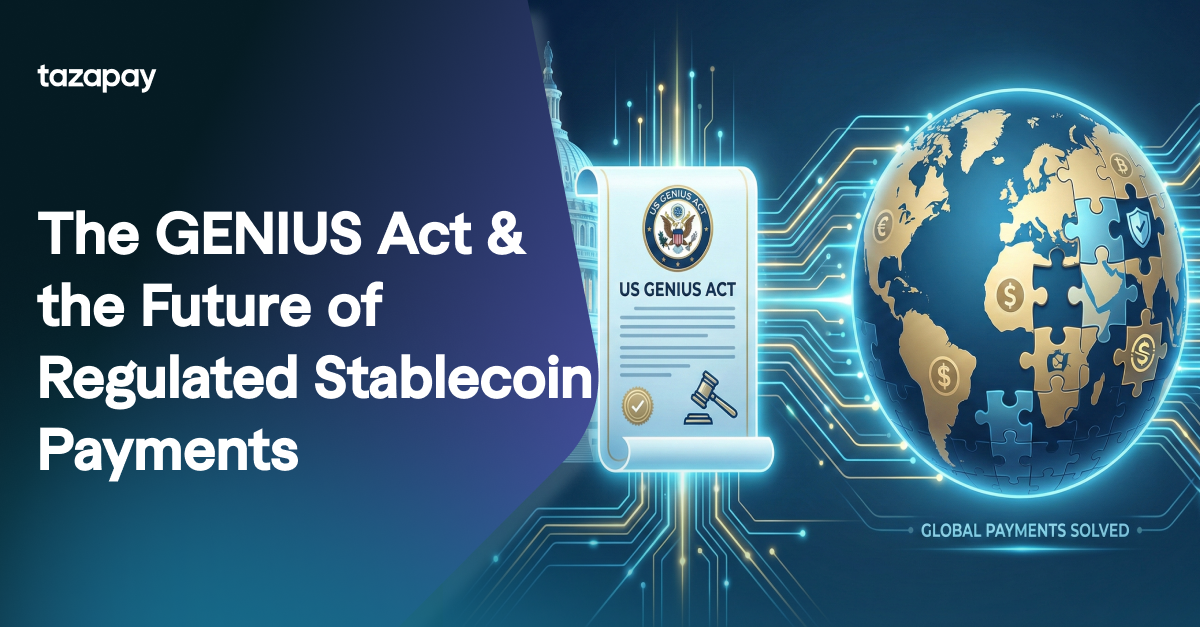
The transition from experimentation to execution in the digital asset space is no longer a future projection. With the passage of the Guiding and Establishing National Innovation for U.S. Stablecoins Act (GENIUS Act) in July 2025, the global financial landscape has entered a new era of regulated certainty.
As we approach July 18, 2026, the date when final rules are expected to be fully established, the industry is moving away from fragmented workarounds toward a unified, auditable infrastructure. For businesses operating across borders, this shift is not just about compliance: it is about a fundamental change in how value is moved, settled, and secured.
The GENIUS Act has effectively ended years of hesitation by formally recognizing stablecoins as regulated payment and settlement instruments. By moving stablecoins into a federal regulatory framework, the Act distinguishes them from speculative assets. This provides the legal foundation required for treasury managers to treat stablecoins as a legitimate component of daily financial operations.
Before this legislation, the primary barrier to the widespread adoption of stablecoins in B2B commerce was regulatory uncertainty. Many organizations hesitated to integrate digital assets into their treasury or payment flows due to the "gray area" surrounding their classification. The upcoming July 18, 2026 deadline for final rules represents several critical shifts for the industry:
.png)
Traditional cross border payment systems are notoriously fragmented. A single international transaction often passes through multiple correspondent banks, each adding fees and increasing the time to settlement. This T+3 or T+5 settlement cycle creates significant liquidity challenges for global businesses.
Regulated stablecoins solve this by acting as a unified settlement layer. Because they operate on 24/7 programmable rails, settlement can happen almost instantly. However, speed is only one part of the equation. In a post GENIUS Act world, the value lies in the regulated nature of that speed.
By utilizing our infrastructure built on regulated rails, businesses avoid the risks associated with unapproved providers. The ability to move from fiat to stablecoin and back again through licensed entities ensures that every transaction is compliant with Anti Money Laundering (AML) standards. This level of auditability is what allows stablecoin usage to scale from small pilot programs to high volume commercial operations.
In the B2B segment, stablecoin payment volumes have already surged from less than 100 million dollars per month in early 2023 to more than 6 billion dollars per month by mid‑2025, a 30‑fold increase in just two years. Much of this activity is concentrated in cross‑border corridors such as US–Asia and intra‑Asia flows, where traditional correspondent banking is slowest and most expensive. (Source)
For a global business, the decision to move to stablecoin settlement is often driven by a need for better capital efficiency. When money is stuck in transit for three to five days, it is capital that cannot be used for payroll, inventory, or investment. By shortening the settlement cycle to minutes, businesses can significantly improve their day's sales outstanding (DSO) and optimize their working capital.
However, moving to stablecoins at scale requires more than just a digital wallet. It requires a sophisticated bridge between the legacy banking world and the new digital rails. This is where the importance of licensed onramp and offramp partners becomes clear. A business must be able to move high volumes of fiat currency into stablecoins and back again without triggering compliance red flags or experiencing significant price slippage.
In the 2026 landscape, this operational efficiency is built on:
While the GENIUS Act is a piece of United States legislation, its impact is global. Much like how GDPR became the de facto global standard for data privacy, the GENIUS Act is setting the blueprint for how stablecoins are regulated worldwide.
Jurisdictions in Europe, Asia, and Canada are closely aligning their frameworks to ensure interoperability with the United States dollar denominated stablecoin market. This harmony is essential for global commerce. When a business uses a partner like Tazapay Canada Corp, which is a registered Money Services Business (MSB) under FINTRAC, they are tapping into a network that respects these evolving global standards.
As the July 2026 deadline approaches, we believe the definition of trust in the payments industry is being redefined by four specific pillars:
For the past decade, stablecoins were often viewed as a tool for early adopters or a hedge against volatility in other digital assets. The GENIUS Act has changed that perception permanently. We are now in the phase of "regulated execution."
This means that the strategic question for businesses has moved from "should we use this technology" to "how do we integrate this technology into our existing stack." Regulatory ambiguity is no longer an excuse for maintaining inefficient, fragmented payment setups.
The timing is critical: by 2030, multiple studies suggest that 5–10% of global payments could be settled in stablecoins, implying that between now and 2026 the industry will experience a steady ramp up in the share of cross‑border volume moving onto tokenized rails. For CFOs, treating 2025–2026 as the window to operationalize GENIUS‑ready infrastructure is less about experimentation and more about keeping pace with where trillions in value are already flowing. (Source)
The final rules expected by July 18, 2026, will provide the definitive checklist for what constitutes a safe, compliant, and scalable payment operation.
For CFOs, this is an opportunity to lead a digital transformation that goes beyond simple cost cutting. It is an opportunity to build a more resilient and responsive financial infrastructure that is ready for the demands of 24/7 global trade.
The era of experimentation is over. The GENIUS Act has provided the roadmap, and we are now moving into a phase of regulated execution. For businesses looking to solve the complexities of cross border payments, the choice of infrastructure has never been more critical.
By building on regulated rails, organizations can finally realize the full potential of digital assets at scale. Whether it is reducing the cost of international transfers, automating vendor payments, or optimizing treasury flows, the benefits of regulated stablecoins are now accessible to every global business. The transition to this new standard of trust starts now.

Global businesses continuously seek ways to reduce costs and streamline international transactions. Two popular solutions have emerged—FX accounts and stablecoin payments. While FX accounts have long been the go-to for managing foreign exchange and cross-border transfers, stablecoins are challenging the status quo with blockchain-powered efficiency. This article breaks down the cost structures, speed, transparency, and overall operational efficiency of both options, helping you decide which best suits your business needs.
FX accounts enable businesses to hold and convert multiple currencies. They are widely used for managing international trade, hedging currency risk, and paying suppliers abroad. However, traditional FX accounts come with several challenges:
Stablecoins, like USDT and USDC, are digital assets pegged to fiat currencies, providing a stable store of value with the benefits of blockchain technology:
Innovative fintech providers are further enhancing this model by offering onramp/offramp services that let you convert fiat to stablecoins—and back—efficiently, ensuring you get the best of both worlds.
Many businesses are already making the switch:
Both systems face their own sets of challenges:
The digital payments landscape is evolving rapidly:
When comparing FX accounts to stablecoin payments for cross-border transactions, the advantages of stablecoins are hard to ignore:
For global businesses aiming to optimize cross-border payments, stablecoins present a compelling, cost-effective alternative to conventional FX accounts. By leveraging innovative solutions and staying informed about regulatory developments, companies can reduce costs, enhance liquidity, and maintain a competitive edge in today’s interconnected world.
**Disclaimer: The stablecoin-related services referenced in this content are provided solely by Tazapay Canada Corp., and not by Tazapay Singapore Pte Ltd.


