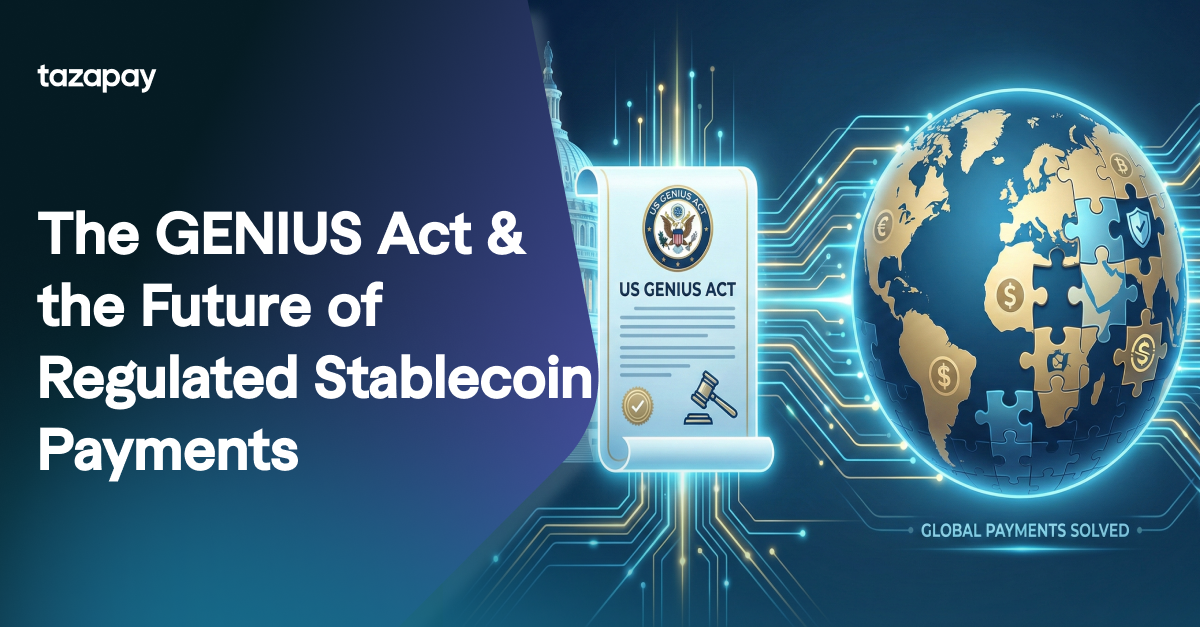
The transition from experimentation to execution in the digital asset space is no longer a future projection. With the passage of the Guiding and Establishing National Innovation for U.S. Stablecoins Act (GENIUS Act) in July 2025, the global financial landscape has entered a new era of regulated certainty.
As we approach July 18, 2026, the date when final rules are expected to be fully established, the industry is moving away from fragmented workarounds toward a unified, auditable infrastructure. For businesses operating across borders, this shift is not just about compliance: it is about a fundamental change in how value is moved, settled, and secured.
The Death of Ambiguity: Understanding the GENIUS Act
The GENIUS Act has effectively ended years of hesitation by formally recognizing stablecoins as regulated payment and settlement instruments. By moving stablecoins into a federal regulatory framework, the Act distinguishes them from speculative assets. This provides the legal foundation required for treasury managers to treat stablecoins as a legitimate component of daily financial operations.
Before this legislation, the primary barrier to the widespread adoption of stablecoins in B2B commerce was regulatory uncertainty. Many organizations hesitated to integrate digital assets into their treasury or payment flows due to the "gray area" surrounding their classification. The upcoming July 18, 2026 deadline for final rules represents several critical shifts for the industry:
- Legal Classification: Stablecoins are now formally recognized as payment instruments rather than just digital commodities or securities.
- Standardized Compliance: We are seeing a transition from optional adoption to a federally mandated framework for issuers and service providers.
- The End of Shadow Crypto: Businesses are no longer forced to use unregulated onramps or opaque settlement layers to access digital asset benefits.
- Institutional Security: The act provides clear guidelines for how banks and financial institutions can interact with stablecoin rails without risking regulatory friction.
Solving the Fragmentation of Cross Border Payments
.png)
Traditional cross border payment systems are notoriously fragmented. A single international transaction often passes through multiple correspondent banks, each adding fees and increasing the time to settlement. This T+3 or T+5 settlement cycle creates significant liquidity challenges for global businesses.
Regulated stablecoins solve this by acting as a unified settlement layer. Because they operate on 24/7 programmable rails, settlement can happen almost instantly. However, speed is only one part of the equation. In a post GENIUS Act world, the value lies in the regulated nature of that speed.
By utilizing our infrastructure built on regulated rails, businesses avoid the risks associated with unapproved providers. The ability to move from fiat to stablecoin and back again through licensed entities ensures that every transaction is compliant with Anti Money Laundering (AML) standards. This level of auditability is what allows stablecoin usage to scale from small pilot programs to high volume commercial operations.
In the B2B segment, stablecoin payment volumes have already surged from less than 100 million dollars per month in early 2023 to more than 6 billion dollars per month by mid‑2025, a 30‑fold increase in just two years. Much of this activity is concentrated in cross‑border corridors such as US–Asia and intra‑Asia flows, where traditional correspondent banking is slowest and most expensive. (Source)
The Operational Reality of Stablecoins at Scale
For a global business, the decision to move to stablecoin settlement is often driven by a need for better capital efficiency. When money is stuck in transit for three to five days, it is capital that cannot be used for payroll, inventory, or investment. By shortening the settlement cycle to minutes, businesses can significantly improve their day's sales outstanding (DSO) and optimize their working capital.
However, moving to stablecoins at scale requires more than just a digital wallet. It requires a sophisticated bridge between the legacy banking world and the new digital rails. This is where the importance of licensed onramp and offramp partners becomes clear. A business must be able to move high volumes of fiat currency into stablecoins and back again without triggering compliance red flags or experiencing significant price slippage.
In the 2026 landscape, this operational efficiency is built on:
- Real Time Liquidity: The ability to convert fiat to stablecoins and settle with partners instantly, regardless of banking hours or public holidays.
- Programmable Payments: Using smart contracts to automate settlement when specific conditions are met, such as the delivery of goods or the verification of a service.
- Consolidated Treasury: Managing a single digital pool of value that can be deployed to any market globally, rather than maintaining dozens of fragmented local currency accounts.
The Global Ripple Effect: Defining Trust in 2026
While the GENIUS Act is a piece of United States legislation, its impact is global. Much like how GDPR became the de facto global standard for data privacy, the GENIUS Act is setting the blueprint for how stablecoins are regulated worldwide.
Jurisdictions in Europe, Asia, and Canada are closely aligning their frameworks to ensure interoperability with the United States dollar denominated stablecoin market. This harmony is essential for global commerce. When a business uses a partner like Tazapay Canada Corp, which is a registered Money Services Business (MSB) under FINTRAC, they are tapping into a network that respects these evolving global standards.
As the July 2026 deadline approaches, we believe the definition of trust in the payments industry is being redefined by four specific pillars:
- Licensed Onramp and Offramp Infrastructure: Trust is built on the presence of regulated rails that ensure entry and exit points of the financial system are secure.
- Auditable Fiat to Stablecoin Flows: Transparency is no longer optional. Every conversion must be traceable and compliant to simplify tax and treasury reporting.
- Clear Fund Custody Across Jurisdictions: Working with regulated entities like Tazapay Canada Corp ensures that fund custody is clear and protected across legal environments.
- Interoperability Standards: Global markets are aligning their frameworks to ensure they can interact seamlessly with US dollar denominated rails, preventing the creation of new "digital silos."
The Strategic Shift from Experimentation to Execution
For the past decade, stablecoins were often viewed as a tool for early adopters or a hedge against volatility in other digital assets. The GENIUS Act has changed that perception permanently. We are now in the phase of "regulated execution."
This means that the strategic question for businesses has moved from "should we use this technology" to "how do we integrate this technology into our existing stack." Regulatory ambiguity is no longer an excuse for maintaining inefficient, fragmented payment setups.
The timing is critical: by 2030, multiple studies suggest that 5–10% of global payments could be settled in stablecoins, implying that between now and 2026 the industry will experience a steady ramp up in the share of cross‑border volume moving onto tokenized rails. For CFOs, treating 2025–2026 as the window to operationalize GENIUS‑ready infrastructure is less about experimentation and more about keeping pace with where trillions in value are already flowing. (Source)
The final rules expected by July 18, 2026, will provide the definitive checklist for what constitutes a safe, compliant, and scalable payment operation.
For CFOs, this is an opportunity to lead a digital transformation that goes beyond simple cost cutting. It is an opportunity to build a more resilient and responsive financial infrastructure that is ready for the demands of 24/7 global trade.
Conclusion: Preparing for a Regulated Future
The era of experimentation is over. The GENIUS Act has provided the roadmap, and we are now moving into a phase of regulated execution. For businesses looking to solve the complexities of cross border payments, the choice of infrastructure has never been more critical.
By building on regulated rails, organizations can finally realize the full potential of digital assets at scale. Whether it is reducing the cost of international transfers, automating vendor payments, or optimizing treasury flows, the benefits of regulated stablecoins are now accessible to every global business. The transition to this new standard of trust starts now.