Delayed cross-border payouts are a common but under-analysed source of vendor disputes in global businesses. While disputes are often attributed to contractual terms or operational failures, the underlying cause is frequently settlement uncertainty.
When overseas vendors cannot predict when funds will be credited to their account, it directly affects their ability to manage payroll, suppliers, and production schedules. This uncertainty increases the likelihood of escalations, delayed fulfilment, and strained supplier relationships.
Improving cross-border payout speed and predictability is therefore not merely a payments optimisation. It is a structural requirement for vendor reliability and operational continuity.
Why Payout Timing Has a Direct Impact on Vendor Behaviour
From a vendor’s perspective, payment completion is defined by funds being available, not by payment initiation.
Any gap between initiation and settlement introduces ambiguity. Vendors must account for the possibility that funds may arrive later than expected, or not at all within a usable timeframe. To manage this risk, vendors commonly adjust their behaviour by delaying work commencement, padding delivery timelines, or escalating payment follow-ups more aggressively.
These behaviours are often misinterpreted as inefficiency or lack of responsiveness. In practice, they are rational responses to payout uncertainty rather than performance issues.
Reducing vendor disputes therefore requires addressing the settlement mechanics that create this uncertainty.
How Traditional Cross-Border Payouts Create Settlement Uncertainty
Most international payouts continue to rely on correspondent banking networks and SWIFT-based routing. While these systems enable global reach, they introduce several structural limitations that affect settlement reliability.
A single cross-border payout may pass through multiple intermediary banks before reaching the beneficiary. Each intermediary adds processing time, cut-off dependencies, and reconciliation complexity. Settlement timelines are influenced by time zones, local banking hours, and intermediary queues, none of which are fully visible to the sender or recipient.
As a result, even when average settlement times appear acceptable, variability remains high. Vendors cannot reliably predict when funds will arrive, and finance teams cannot provide definitive timelines when queried.
This variability, rather than absolute delay, is the primary driver of vendor disputes in cross-border payments.
Predictability Matters More Than Absolute Speed
While faster payouts are beneficial, predictability has a greater influence on vendor confidence and dispute reduction.
A vendor that consistently receives funds within a known timeframe can plan operations accordingly, even if settlement is not instantaneous. In contrast, settlement estimates expressed as broad ranges such as “three to five business days” force vendors to assume worst-case scenarios.
This assumption leads to defensive behaviour, including delayed fulfilment and frequent follow-ups. By reducing settlement variability and providing consistent timelines, businesses can materially improve vendor trust without necessarily achieving instant settlement.
Operational Impact of Payout Delays Beyond Finance Teams
The consequences of slow or unpredictable payouts extend beyond finance functions.
Delayed vendor payments can disrupt production schedules, delay deliveries, and trigger internal escalations across procurement, operations, and account management teams.
What begins as a payment issue can quickly become an organisation-wide distraction.
These indirect costs are often significantly higher than the direct cost of the payout itself. Improving payout reliability therefore delivers benefits across multiple functions, not only within finance.
The Infrastructure Behind Predictable Vendor Payouts
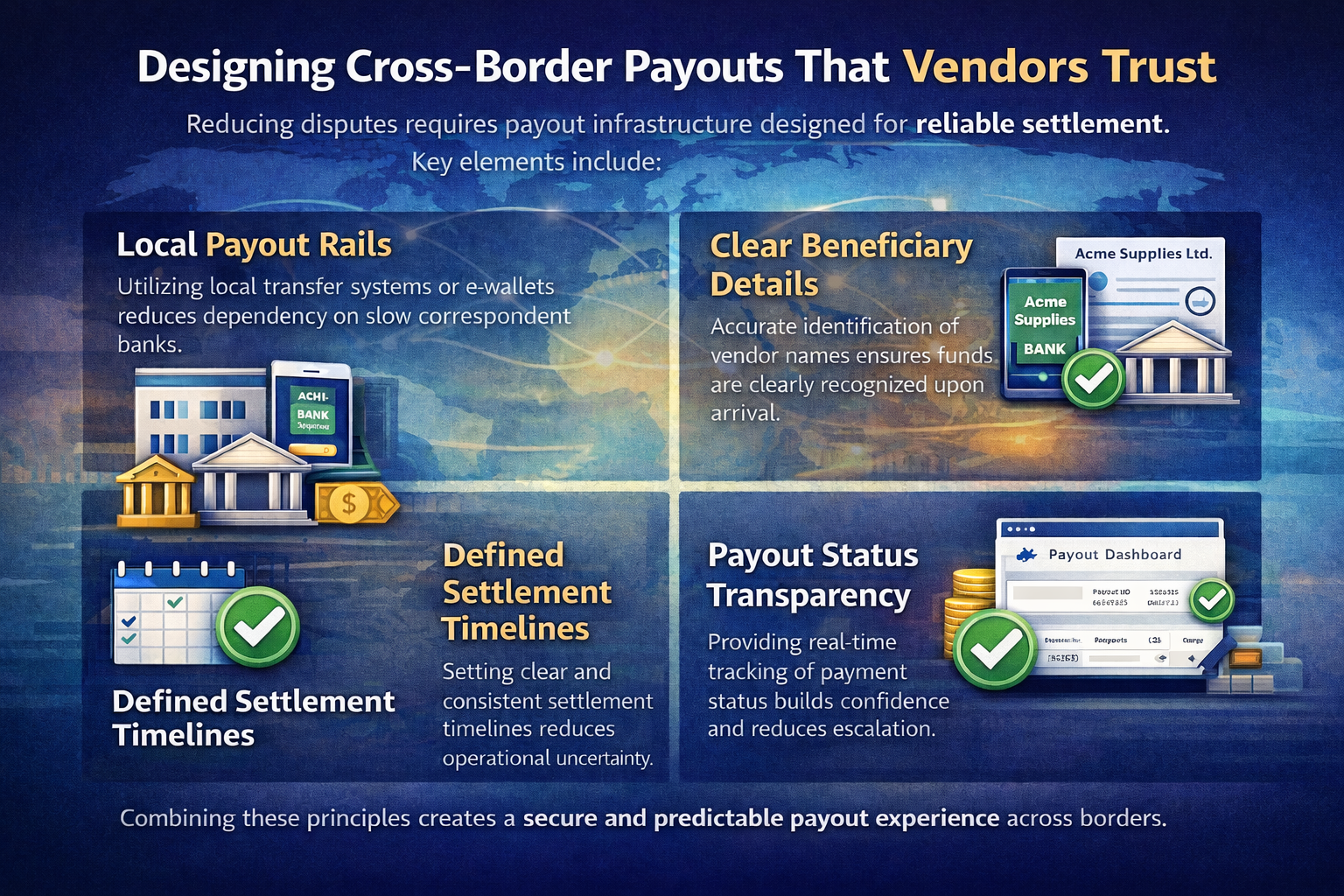
Reducing disputes requires payout infrastructure designed for settlement certainty. Effective designs typically include the following elements:
1. Use of Local Payout Rails
Where available, routing payouts through local bank transfers, e-wallets or domestic payment methods reduces reliance on correspondent banking networks. Local rails generally offer clearer settlement timelines, lower variability, and greater familiarity for recipients.
2. Clear Beneficiary Identification
Accurate and recognisable beneficiary naming ensures vendors can immediately identify incoming funds, reducing confusion and unnecessary follow-ups.
3. Defined Settlement Timelines
Clear and consistent settlement expectations enable vendors to plan operations confidently and reduce the need for defensive buffers.
4. Operational Visibility
Visibility into payout status allows finance and operations teams to communicate accurately with vendors, preventing speculation and escalation when delays occur.
Together, these elements transform payouts from a source of uncertainty into a predictable operational process.
Role of Modern Payout Infrastructure
Modern payout infrastructure addresses these challenges by combining cross-border orchestration with local payout rails across multiple markets.
Tazapay enable businesses to route payouts through appropriate local rails or ewallets where available, achieving instant or same-day settlement in many corridors. By integrating payouts with broader money movement capabilities such as collections and balances, payouts become part of a designed end-to-end flow rather than a fragmented final step.
This approach improves settlement predictability, reduces operational ambiguity, and allows businesses to manage vendor payouts with greater confidence.
Evaluating Cross-Border Payouts Beyond Cost
Cross-border payouts are often evaluated primarily on pricing. While cost efficiency is important, it provides an incomplete view of payout performance.
A lower-cost payout that introduces settlement variability and disputes may ultimately be more expensive once operational overhead, vendor friction, and internal escalation costs are considered.
A more effective evaluation framework considers:
- Settlement speed and consistency
- Visibility and transparency
- Vendor experience and trust
- Impact on operational reliability
By prioritising these factors, businesses can align payout design with broader operational and supplier management objectives.
Conclusion
Vendor disputes in cross-border business are frequently symptoms of payout uncertainty rather than contractual disagreement or operational failure.
By improving payout speed and, critically, payout predictability, businesses can reduce disputes, strengthen vendor relationships, and improve supply chain reliability. This requires moving beyond traditional correspondent banking models and adopting payout infrastructure designed for consistency, visibility, and local settlement.
Cross-border payouts should therefore be treated as a strategic component of vendor reliability, not merely a back-office function.