TL;DR
The Checkout Problem in Thailand
Thailand is one of Southeast Asia's fastest-growing digital economies, and its consumers are increasingly mobile-first. For international businesses selling to Thai customers, the recurring obstacle is not demand. It is checkout success.
Credit and debit cards remain important, but they often fall short. Transactions are declined more frequently, card coverage thins outside urban centres, and foreign exchange costs discourage buyers. The result is abandoned checkouts and lost revenue.
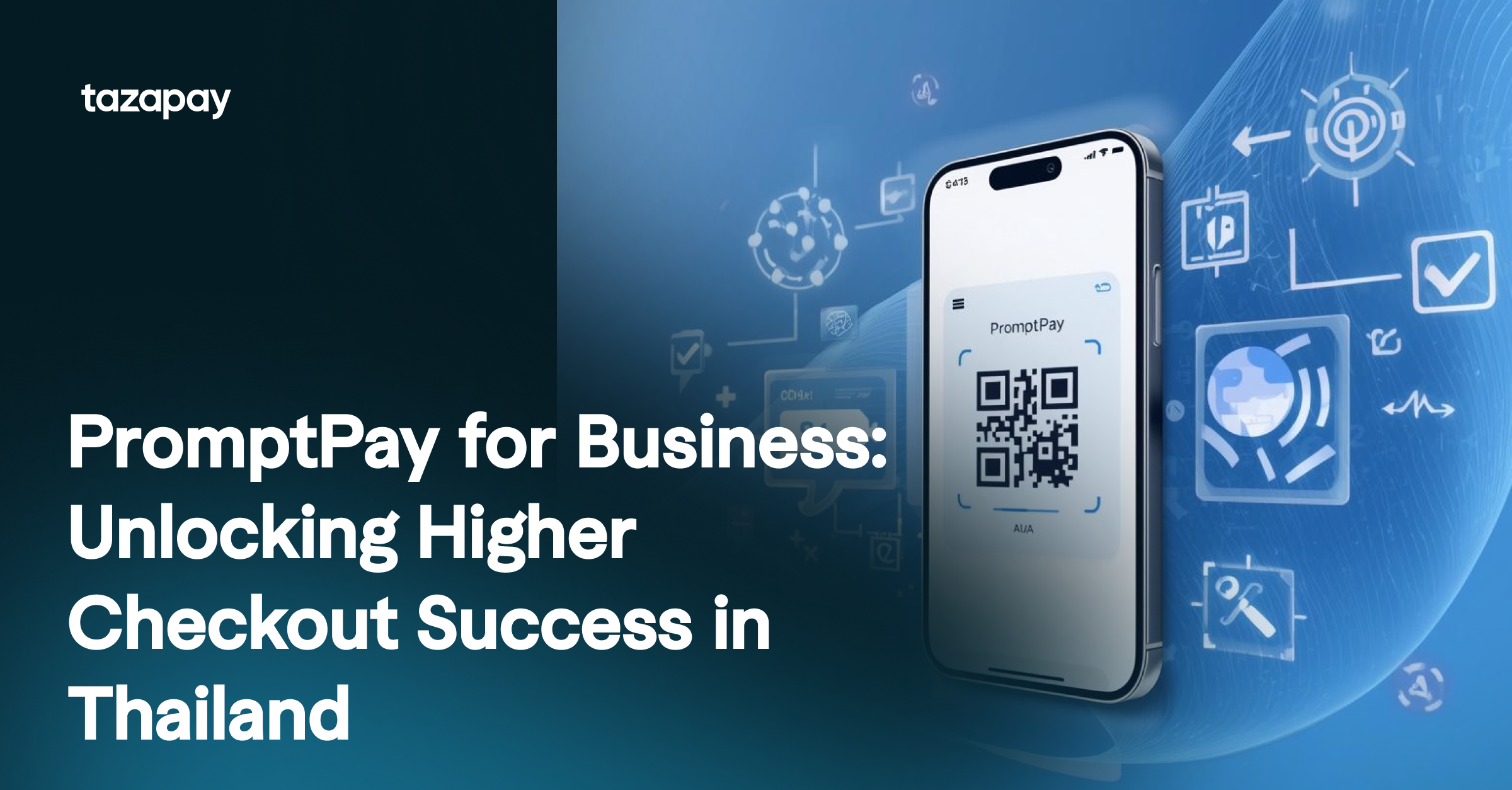
PromptPay, Thailand's national QR-based payment system overseen by the Bank of Thailand and National ITMX, has become the mainstream alternative. For businesses selling into Thailand, offering it alongside cards is now the difference between capturing a sale and losing it at the final step.
PromptPay's Scale
PromptPay adoption has grown to the point where it is an expectation at Thai checkout rather than a differentiator.
- In March 2025, PromptPay reached 81.06 million registrations, covering close to the entire adult population [1].
- That same month it processed 2.1 billion transactions worth more than 4.43 trillion baht, a 13% year-on-year increase [2].
- By July 2025, monthly volume reached 2.36 billion transactions, with a total value of about 4.5 trillion baht [3].
- Cross-border usage is accelerating. In February 2025, PromptPay cross-border QR transactions totalled 296 million baht, up 119% year on year [4].
- Adoption is cultural as well as functional. In 2024, 61.5% of Thailand's population used QR codes monthly, placing the country among the world's leaders in QR adoption [5].
The trajectory shows PromptPay moving from a domestic initiative to a tool that international businesses need to support to compete for Thai customers.
Where PromptPay Lifts Checkout Success
The pattern is consistent across sectors: PromptPay succeeds where cards fail, so adding it captures transactions that would otherwise be abandoned.
E-commerce and marketplaces see high cart abandonment in Thailand from card failures and buyer hesitation. Offering PromptPay lets customers pay on the spot by scanning a QR code, which raises completed orders and reduces abandoned carts. PromptPay has become a default option for Thai shoppers.
Travel businesses face failed transactions at checkout, particularly on mid-value purchases like hotel reservations and tour bookings. PromptPay lets travellers pay on the spot in Thai baht with a familiar method and provides immediate confirmation, which raises booking confidence and reduces drop-offs.
Digital products and gaming serve one of Asia's most engaged digital populations, but micro-transactions and one-off purchases often fail on card-only checkouts. PromptPay lets small and mid-ticket purchases go through quickly and reaches younger buyers who may not hold international cards.
Education and edtech platforms find that many Thai students and professionals lack international-ready cards, which becomes a barrier to enrolment. PromptPay provides a widely trusted baht-denominated option that reduces failed-card drop-offs and expands reach for global providers.
The Business Impact of Cards Plus PromptPay
Businesses that offer multiple payment options serve more customers and reduce payment risk. In Thailand specifically, adding PromptPay alongside cards produces four effects:
- Authorisation rates improve, because PromptPay succeeds where cards are declined.
- Cart abandonment decreases, as customers complete payment with their preferred method.
- Trust increases, from the presence of a familiar local option.
- Cash flow improves, because PromptPay settlements are typically same day.
PromptPay complements cards rather than replacing them. Together they capture the widest possible customer base. The alternative, relying on cards or international transfers alone, means lost revenue from customers unwilling or unable to use cards, higher decline rates, checkout abandonment from friction, and the delays and costs of cross-border transfers that are unsuitable for small and mid-value transactions.
For the full picture of how PromptPay sits within Thailand's payment landscape, including TrueMoney, bank transfers and the wider wallet market, see our guide to local payment methods in Thailand.
How to Enable PromptPay Without a Thai Entity
The complexity of enabling PromptPay for a cross-border business sits in the setup, not the customer experience. A provider abstracts that complexity in a few ways.
Hosted checkout allows fast integration and go-live within days, suitable for businesses that want speed. White-label checkout gives larger enterprises a fully branded customer experience. Unified payments combine PromptPay with cards, other local payment methods and local bank transfers in a single integration. And crucially, the arrangement requires no Thai entity, which lets global businesses collect directly without establishing a local company.
Whether the priority is speed or brand control, the goal is the same: add PromptPay to lift authorisation rates and settle faster.
For businesses that also pay out to Thai suppliers, partners or sellers, the same local rails matter on the disbursement side. And for the wider regional view, see our guide to e-wallets across Southeast Asia.
Sources
[1] Mastercard and National ITMX. "Mastercard and National ITMX Announce Extended Collaboration in Real-Time Payments." March 2025.
[2] Payment Expert. "Thailand Expands PromptPay with Mastercard in New Deal." June 2025.
[3] Bank of Thailand. Payment Systems Statistics. 2025.
[4] Bank of Thailand. "Cross-Border Payment." 2025.
[5] Money and Banking Thailand. "QR Code Adoption in Thailand." 2025.